Automating Corporate Travel Approvals: A Practical Guide
By Dominic Marc Short · 8 October 2026 · 15 min read

What if the fastest travel approval is the one that never needs a meeting, but still leaves a person firmly in charge? For teams automating corporate travel approvals, that’s the useful distinction: routine requests can follow clear policy rules, while unusual trips still reach an accountable decision-maker. It’s a sensible aim, especially when requests arrive by email, chat and forms with key details missing, leaving approvers to play part-time detective before they can say yes or no.
Most organisations know automation can reduce repetitive administration. The harder question is how to make decisions transparent, consistent and easy to explain, without turning exceptions into a digital dead end. Employees should know who reviews a request and what happens next; approvers should see the information they need, not another thread asking for the itinerary.
This guide explains how to design an approval workflow around your travel policy, set routes for routine requests and exceptions, and keep useful records and reporting. It also considers the people and change management behind implementation, because a new system works best when the process makes sense before anyone clicks “submit”.
Table of Contents
- Why automate corporate travel approvals when the process already works?
- How does an automated corporate travel approval workflow operate?
- Which approval automation approach balances efficiency and control?
- How to introduce corporate travel approval automation step by step
- How can travel management consulting support approval automation?
Why automate corporate travel approvals when the process already works?
A process can appear to work while quietly relying on employees to remember who approves what, approvers to spot missing information and someone to chase a decision. Travel approval automation uses software to route requests according to agreed rules and decision rights. The request still needs organisational judgement; the workflow simply makes the steps, ownership and status easier to follow. For context, the Business Travel Overview outlines the purpose and common practices of business travel, which shape the information an organisation may need before approving a trip.
Manual processes often stall at handovers. An employee may send a request by email without dates or estimated spend. The recipient may not know whether a line manager, budget holder or another approver owns the decision. The request then returns for clarification, is checked again by someone else or sits in an inbox while the employee asks for an update. These delays are operational friction, not necessarily evidence that the travel policy itself is wrong.
That distinction matters. Automation can make an agreed policy easier to apply, but it cannot resolve disagreements about what the policy should allow. If the rules are unclear, the workflow may simply deliver inconsistent decisions more efficiently, which is a brisk but unhelpful achievement. Clarify the policy and decision rights first, then configure the process around them.
Which parts of a travel approval process are repetitive?
Consider a typical request for a work trip. The employee provides the trip purpose, dates, estimated spend and traveller details. Someone checks that these fields are complete, identifies the appropriate approver and prompts the reviewer to consider relevant policy criteria. These are repeatable steps, provided the organisation has agreed what information is required and which roles make each decision.
- Completeness: Flag missing dates, purpose or cost information before the request moves forward.
- Routing: Send the request to the person or role responsible for reviewing it.
- Policy prompts: Surface the agreed criteria for the approver to consider.
These checks can reduce avoidable back-and-forth, but only when the criteria are specific enough to apply consistently. A vague instruction such as “seek approval for unusual travel” needs interpretation; it is not yet a dependable workflow rule. For each proposed rule, define the condition that triggers it, the role responsible for the decision and what happens if the request does not meet the standard route.
What should remain a human decision?
Unusual, sensitive or ambiguous requests need a named human decision-maker. A workflow can identify that a request falls outside a configured rule and direct it for review, but it should not disguise uncertainty as an automatic decision. Policy owners define acceptable rules and decision rights; the tool applies the steps they have agreed.
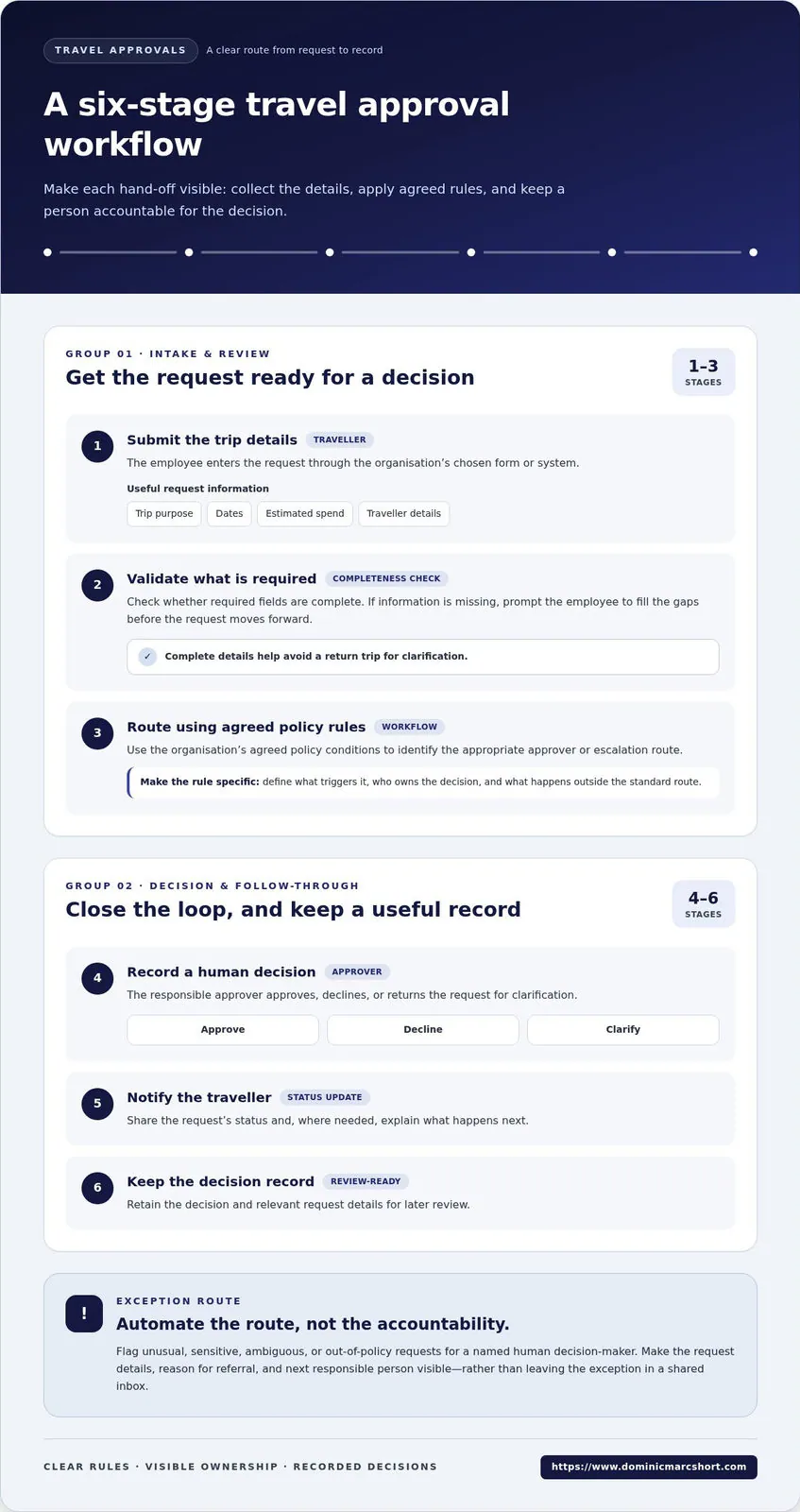
Set an escalation route for requests that fall outside standard criteria, and make ownership visible. The exception should arrive with its details, reason for referral and next responsible person, rather than disappearing into a shared inbox. This is the difference between automating administration and handing every judgement to software: automate the route, not the accountability.
Organisations considering strategic business travel consulting can use process analysis to clarify those rules before technology is configured. That sequence helps teams identify which steps are genuinely repetitive, where human review adds value and what a useful approval record should show.
How does an automated corporate travel approval workflow operate?
A well-designed workflow makes the journey of a request visible, from the employee’s first submission to the recorded decision. The exact setup will vary, but the sequence should be clear: collect the information needed, apply agreed checks, send the request to the right person and tell the traveller what happens next. When automating corporate travel approvals, the aim is a dependable process, not a maze with a login screen.
A practical request-level workflow can follow these stages:
- 1. Submit: The traveller enters trip details through the organisation’s chosen form or system.
- 2. Validate: The workflow checks whether required fields are complete and prompts the employee to fill any gaps.
- 3. Route: Agreed policy conditions determine the appropriate approver or escalation route.
- 4. Decide: The responsible approver approves, declines or returns the request for clarification.
- 5. Notify: The traveller receives a status update and, where needed, an explanation of the next step.
- 6. Record: The system retains the decision and relevant details for later review.
A routine request that meets defined criteria might go to a line manager or budget holder through a standard route. A request outside those criteria should be flagged for the appropriate human review, rather than silently treated as approved or rejected. The routing should reflect the organisation’s decision rights, not assumptions built into a software template.
What information should a travel request capture?
Ask for details that help someone make a decision: the trip purpose, dates, destination and estimated travel details. Each field should support a clear check, such as confirming the business reason, reviewing timing or assessing expected spend. If a question has no bearing on approval or a defined process, consider whether it belongs in the request at all. Clear prompts also show employees what information is expected, reducing incomplete submissions and follow-up messages.
Keep the form focused. For example, a prompt for estimated spend should explain what the employee is being asked to estimate, rather than leaving them to guess which costs count. The aim is enough context for a fair decision, not an itinerary-length essay. Before launch, have someone unfamiliar with the form complete it and note any question they have to interpret.
How should the system route requests and record decisions?
Routes should match defined roles, spending authority and relevant policy conditions. Configure distinct outcomes for approval, rejection, a request returned for more information and an exception requiring escalation. Notifications should state the status and the action, if any, required from the traveller or approver. A decision record is most useful when it captures who decided, when they decided and any relevant rationale.
System hand-offs should support the process, not dictate its shape. Some organisations may connect approval information with booking or finance tools; others may begin with a standalone workflow. Choose only the hand-offs that improve visibility or prevent duplicate entry, and define which system holds the authoritative record. Policy rules set the boundaries, workflow routing moves each request, and accountable approvers make the decisions.
For teams refining how policy and technology fit together, business travel transformation guidance can help frame the workflow around practical decision-making, rather than starting with software features.
Which approval automation approach balances efficiency and control?
The right level of automation depends on how predictable each decision is. A straightforward request under clear policy conditions may need only a standard route. A request involving competing priorities or missing context needs a person who can weigh the circumstances. The choice is not simply between paper forms and a fully automated system; there are several useful points along the way.
Faster routing is not proof that policy decisions or outcomes have improved. A workflow may move requests promptly while applying a poorly understood rule, routing to the wrong role or obscuring why a decision was made. Review both process performance and decision quality: are requests reaching the right person, are exceptions being handled visibly, and can the organisation explain the rationale recorded?
The main concern is understandable: does automation remove human judgement? It should not. Automating corporate travel approvals means using rules for predictable administration while retaining human approval wherever judgement, context or accountability requires it. A well-designed process gives approvers clearer information, not less responsibility.
When is rule-based approval enough?
Rule-based routing suits clear, stable conditions, such as whether estimated spend falls within an organisation’s defined approval limit or whether a request meets its stated booking criteria. Each rule needs a named policy owner and periodic review as business needs change. If two rules conflict, or a phrase such as “reasonable cost” has no shared meaning, resolve that process issue before configuring it.
When should an exception go to a person?
Refer policy deviations, incomplete context and competing priorities to an accountable approver. Define who owns each escalation and what response is expected, without assuming every organisation needs the same timetable. Exception reports can then show repeated referrals, common reasons and points where policy creates friction, giving policy owners evidence to consider when they review the process.
For organisations refining their rules, a focused corporate travel policy framework can help connect approval criteria with decision rights. That groundwork makes it easier to choose what to automate, what to escalate and where people should remain firmly in the loop.
How to introduce corporate travel approval automation step by step
Introducing automation is a process-design and organisational-change exercise, not simply a matter of switching on a new tool. A staged approach gives people time to agree how decisions should work, test the workflow and resolve snags before they become everyone’s problem. Involve travel, finance, approvers, employees and technology stakeholders early; each group sees different parts of the process, and those perspectives help expose gaps before launch.
- Map the current process. Record how requests arrive, who reviews them, where decisions pause and what information is often missing.
- Clarify the policy. Resolve ambiguous or conflicting conditions and confirm who owns each decision.
- Design routes. Translate agreed decision rights and criteria into standard approval paths and clear exception routes.
- Test the workflow. Use a small pilot to check ordinary requests, exceptions, notifications and decision records.
- Launch with guidance. Explain the new steps and responsibilities to employees and approvers before they use the process.
- Review and refine. Use workflow data and feedback to identify what needs adjustment.
Keep the pilot manageable, but make its scenarios realistic. A smooth routine request is only part of the story; the process also needs to cope with missing details, a policy deviation and a request that reaches the wrong approver. Record what happened in each scenario, including whether the request reached the right person and whether the instructions made the next step clear.
How do you prepare policies and workflow requirements?
Start by documenting existing approval paths, decision rights, common exceptions and points of delay. Then translate policy wording into explicit, understandable conditions before configuring anything. Agree what information each role can access, what reports are useful and whether a hand-off to another system would remove duplicate work. Requirements should reflect organisational needs, rather than adding integrations because they happen to be available.
For instance, a rule should state which role reviews a request when a defined condition is met, and what happens if that reviewer is unavailable or the request does not fit the standard route. Assign an owner to each key rule so policy updates have a clear home. This preparation also supports structured travel technology implementation, where workflow choices are assessed alongside the wider operating process.
How do you test and support employee adoption?
Test the draft workflow with both travellers and approvers. Ask them to submit an ordinary request, leave a required field incomplete and try a request outside policy. Check that prompts are understandable, notifications reach the right people and the decision record captures what reviewers need. Concise guidance should explain how to submit, what each role does and where an exception goes. Nobody should need a treasure map to find the next step.
After launch, track completion, returned requests or other rework, exception patterns and user feedback. These measures help reveal friction, but they do not guarantee a particular improvement. Look for recurring questions and repeated exceptions, then refine instructions or rules with the relevant owners. A short review cycle keeps the workflow responsive as needs change, without turning every piece of feedback into a new system project.
How can travel management consulting support approval automation?
Automating corporate travel approvals is as much an organisational design question as a technology decision. Travel management consulting can help an organisation examine how requests move today, how policy is interpreted in practice, who owns each decision and where technology could support a clearer process. Dominic Marc Short - Independent Consultant provides business travel management consulting, including process analysis and optimisation, global travel management solutions and digital transformation. This work can bring travel, finance, approvers and technology stakeholders around the same table before implementation begins.
The focus is the approval process: understanding the current model, aligning decision rights and shaping a practical route towards change. It is also important to define the scope of the work clearly, so the organisation knows which process decisions and technology changes the project needs to address. A strategic business travel consulting approach can connect process analysis with the wider objectives of a travel programme.
What should an approval automation review examine?
A useful review looks beyond the form employees complete. It examines existing workflows, how policy is interpreted, who holds approval authority and which exceptions recur. It also considers whether current travel technology can support the required routing, reporting and information flows, and where hand-offs may create unnecessary duplication. Findings can then shape a proportionate implementation plan, informed by a travel technology implementation framework.
For example, a review may find that requests are sent to different approvers depending on local practice, even though the written policy sets out a consistent decision role. That points to a need to clarify ownership before configuring routes. In another case, the approval path may be clear, but the information approvers receive is incomplete. The appropriate response could be to improve request prompts, rather than add a complex system hand-off.
How do process design and change support work together?
Redesigned steps are easier to adopt when people understand their role. Employees need concise guidance on what to submit and how to follow progress; approvers need to know what they decide and how to handle a referral. Dominic Marc Short - Independent Consultant supports clients with bespoke change management communications packages, helping explain what is changing and how people should use the redesigned process. Clear communication helps prevent a familiar process from being replaced by a new process that is technically sound but mysterious to everyone using it.
Review findings can guide implementation in a sensible sequence: resolve policy questions, agree roles, configure and test the workflow, then refine it using experience and feedback. This links technology change with practical ways of streamlining business travel processes, rather than treating each new tool as a standalone fix.
A tailored process analysis can give your organisation a measured next step, whether that means refining existing approval routes or preparing for a broader change. If approval automation is on your agenda, begin with the workflow and the people who rely on it.
Make your next approval step clearer
The most useful next step is not necessarily a new platform. Start by identifying one point where your current approval process creates avoidable effort, then decide what evidence would show whether a change has helped. That gives your team a practical starting point for automating corporate travel approvals, while keeping attention on decision quality and employee experience.
CDABS is an independent consulting firm founded by Dominic Short. Its business travel management consulting covers process analysis, optimisation and digital transformation. Bespoke change management communications can also help employees and approvers understand what is changing and how to use the redesigned process.
A clearer workflow needn’t make approvals less human. With the right groundwork, it can give people more time and better context for the decisions that genuinely need their judgement.
Take the next step with CDABS: discuss your travel approval process and how consulting can help you shape a clearer workflow.
Frequently Asked Questions
What does corporate travel approval automation mean?
Corporate travel approval automation coordinates the administrative steps between a traveller’s request and an authorised decision. It can check required fields, apply agreed routing logic and preserve a traceable status. It doesn’t decide whether a trip is worthwhile; that remains a business judgement. Think of it as a controlled hand-off, not an automatic “yes” button for every journey or an invisible queue where requests go to take a long holiday.
How do you automate business travel approvals?
Begin by documenting who has authority to approve different kinds of requests, then define the information and conditions each decision requires. Configure the chosen workflow to reflect that approval matrix, including a clear route for requests that don’t fit standard criteria. Before wider use, have employees and approvers try realistic scenarios and note where instructions or roles are unclear. This practical groundwork helps keep the workflow aligned with actual responsibilities.
Can travel approvals be automated without a travel management system?
Yes. An organisation can introduce a digital request form and approval workflow without adopting a complete travel management system. The essential requirements are that requests reach the right decision-maker, users can see their status and the organisation can retrieve decision records. Before choosing a setup, consider who will maintain the rules, how access to request information will be managed and whether staff would otherwise need to enter the same details repeatedly.
What happens when a travel request falls outside policy?
A request outside policy should be flagged for review by a person with the relevant authority, rather than being treated as a routine approval. The referral should make clear which condition triggered it and what additional context the reviewer needs. For example, an employee might explain why an alternative itinerary is necessary. The decision-maker can then record the outcome and rationale, giving the employee a clear response and the organisation a useful record.
Does automating corporate travel approvals remove human oversight?
No. Automating corporate travel approvals can reduce repetitive administration, but it shouldn’t remove human accountability for decisions that need judgement. An organisation can assign a named approver to requests involving sensitive circumstances, unclear information or competing business needs. It should also define who can approve an exception and how that decision is recorded. This keeps responsibility visible, even when the routine steps happen automatically.
How can a company measure whether approval automation is working?
Assess more than how quickly requests move. Compare the time spent waiting for a decision with time spent actively reviewing requests, and look at how often submissions are returned for missing information. Review exception outcomes too: repeated referrals may indicate confusing policy or routing. Gather feedback from travellers and approvers, then compare similar request types over time. A balanced view helps distinguish faster administration from genuinely clearer decision-making.
Why do employees resist a new travel approval workflow?
Employees may resist if they don’t understand what has changed, can’t tell who owns a decision or find the new request form more cumbersome than the old one. Some may also worry that automated checks leave no room to explain unusual circumstances. Address these concerns with role-specific guidance, straightforward instructions and a visible way to raise questions or provide context. Early user feedback can reveal confusing steps before workarounds become the unofficial process.
Related articles

19 October 2026 · 14 min read
Corporate Travel Expense Audit Best Practices: A Practical 2026 Guide
Explore corporate travel expense audit best practices to ditch receipt dramas, keep finance smiling, and streamline business travel compliance with ease.

20 October 2026 · 14 min read
Integrating Sustainability into Travel Policy: A Practical 2026 Guide
What if a more sustainable business trip could also be the more practical one? Integrating sustainability into travel policy isn’t about saying “no” to…

5 October 2026 · 13 min read
Communicating Travel Programme Updates to Employees: A Practical Guide
Master communicating travel program updates to employees! Keep staff smiling and journeys smooth with our delightful guide to clear, timely policy rollouts.