How to Convince a CFO to Approve Travel Programme Changes
By Dominic Marc Short · 9 October 2026 · 15 min read

What if the strongest case for changing your travel programme isn’t a promise to spend less, but a clearer view of what travel delivers? If you’re asking how to convince CFO on travel program changes, that distinction matters: a savings claim alone may not explain the commercial value, operational need or trade-offs behind a proposal.
It’s understandable if the case feels difficult to make. Travel costs can be spread across teams and systems, while incomplete data makes it harder to compare current performance with a proposed change. To a CFO, a new process or platform can look like extra cost and complexity unless the benefits are specific and measurable.
This article will help you build a decision-ready case using your organisation’s own evidence. You’ll learn how to compare the status quo with realistic options, connect travel activity to financial and operational outcomes, and propose a proportionate implementation with clear measures of success. The aim isn’t to make every journey look like a bargain; it’s to show where change could improve control and support business priorities.
Table of Contents
- Why travel programme changes need a CFO-ready case
- Build the financial and operational evidence for travel programme changes
- Compare travel programme options and answer the CFO’s objections
- Present a clear approval request for travel programme changes
- Turn CFO approval into measured travel programme change
Why travel programme changes need a CFO-ready case
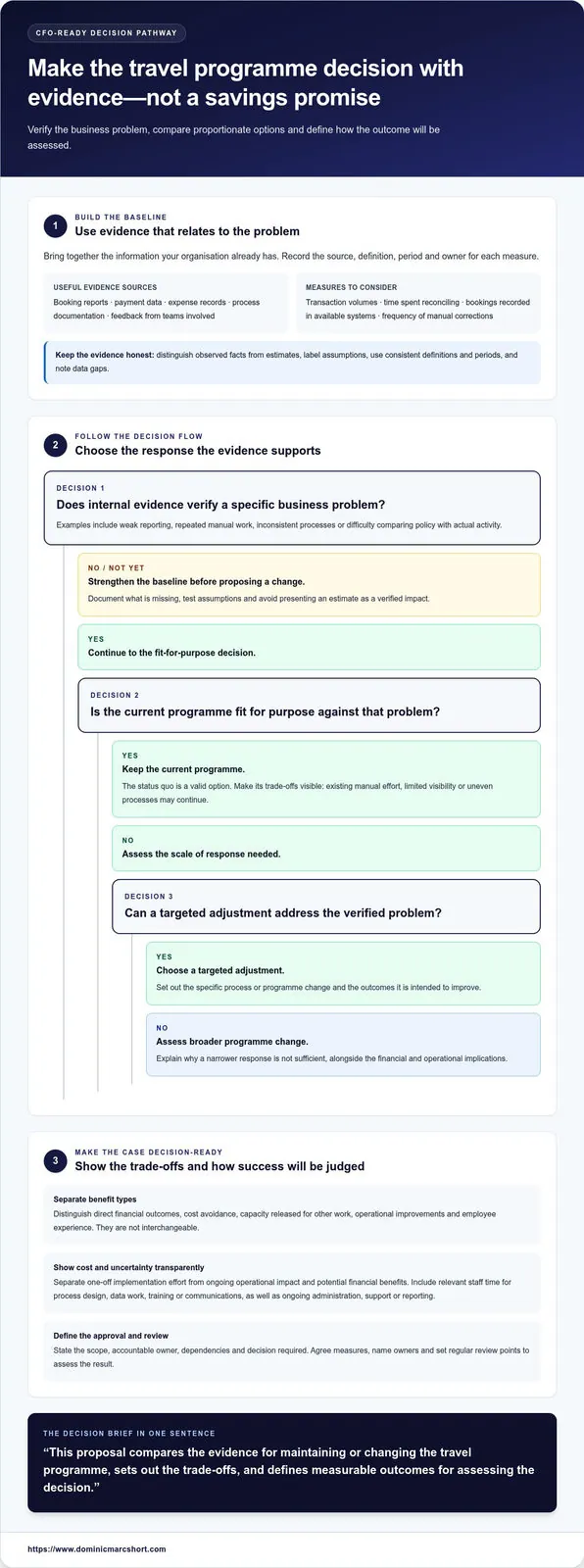
A travel programme change may be necessary to address weak reporting, repeated manual work or inconsistent processes. Yet even a sensible operational improvement can look like extra spend when the proposal starts with a platform, consultancy or new process instead of the problem it is meant to solve. Finance needs to know why a decision is required, what alternatives exist and how the organisation will assess the result.
A CFO-ready case is a concise decision brief linking a verified problem to realistic options, their financial and operational implications, and measures for reviewing outcomes. It also separates the case for changing the programme from the case for buying a particular solution. The first asks whether the current approach is fit for purpose; the second asks which response, if any, is proportionate. Keeping those decisions separate helps prevent a product demonstration from doing the job of a business case.
The status quo is an option, but it is not consequence-free. Existing manual effort, limited visibility or uneven processes may continue if nothing changes. That does not mean change will automatically save money. A credible assessment makes the trade-off visible rather than treating savings as a foregone conclusion. This is central to how to convince CFO on travel program changes: present a balanced decision, not a sales pitch wearing a spreadsheet as a tie.
Start with the business problem, not the proposed solution
Describe a specific friction point in terms people can recognise. For example, finance may need to reconcile travel expenses across separate records, travellers may have to repeat booking details, or programme owners may struggle to compare policy with actual activity. Explain who is affected, how often the issue appears in available records, and what work it creates. Don’t claim a scale or financial impact until internal evidence supports it.
Use evidence the organisation already has, such as expense records, payment data, booking reports, process documentation or feedback from the teams involved. A focused travel data management review can help reveal where information is incomplete or difficult to compare. Separate observed facts from estimates: label each assumption, note how it could be tested, and resist the temptation to make a guess look precise by adding decimal places.
Frame the decision in finance’s terms
Finance needs to understand how the operational problem connects to the decision at hand. Depending on the evidence, that may involve cost control, staff time spent on processes, policy adherence, reporting quality or continuity when a process depends on manual work. The Role of a Chief Financial Officer includes financial stewardship and strategic input, so frame the proposal around the decision and its implications, not just travel administration.
Be precise about the type of benefit. A financial outcome might be a reduction in a verified expense or process cost; an operational benefit might be more consistent reporting; an employee-experience benefit might be a simpler process for travellers. All can matter, but they are not interchangeable. State which outcomes can be measured directly and which need qualitative feedback or a proxy measure.
A useful sentence for the brief is: “This proposal compares the evidence for maintaining or changing the travel programme, sets out the trade-offs, and defines measurable outcomes for assessing the decision.” That framing gives the CFO a clear question to consider, while leaving room for the evidence to support a targeted adjustment, broader change or no change at all.
Build the financial and operational evidence for travel programme changes
With the business problem defined, establish what the current programme actually looks like. Bring together available booking, payment, expense and process information before forecasting benefits. A baseline might include transaction volumes, time spent reconciling expenses, the share of bookings recorded in available systems, or the frequency of manual corrections. Use measures that relate directly to the proposed change, rather than collecting data simply because it happens to be nearby.
Keep periods and definitions consistent. If one report counts bookings and another counts trips, say so; they are not interchangeable just because both fit neatly in a column. Where data is incomplete, record the gap and its likely effect on the analysis. A travel data management audit can help identify where source information needs cleaning or clearer ownership before it supports a decision.
Choose evidence that speaks to the proposed change
Match each intended improvement to a relevant measure. If the issue is manual administration, list the steps involved and the effort they require. If policy adherence is the concern, define what counts as compliant and use records that can reliably show it. For payment visibility, identify which transactions can be matched to travel activity. Note the data source, definition, period and owner beside each measure, so finance can follow the trail without needing a decoder ring.
Present costs, benefits and uncertainty transparently
Separate one-off implementation effort from recurring operational impact and potential financial benefits. Implementation may involve staff time for process design, data work, training or communications; ongoing effort may include administration, support or reporting. Distinguish direct cash savings from cost avoidance, capacity released for other work, and non-financial benefits such as a clearer traveller process. These outcomes can all inform a decision, but they should not be added together as if they were the same kind of return.
Put assumptions beside estimates: who supplied them, what period they cover, and what remains uncertain. A sensitivity view can show how the case changes if adoption is slower, internal effort is higher, or the expected process improvement is smaller. The CFO's Perspective on Corporate Travel ROI can help frame why travel outcomes should be considered alongside the evidence and assumptions behind them.
Estimates are decision inputs, not guaranteed outcomes; their value lies in making assumptions and trade-offs visible. That distinction keeps a credible proposal confident without pretending the future has already signed off.
Use a short, auditable measurement plan
Set out a baseline, an accountable owner, a review period and a small group of measures tied to the approved change. Once delivery begins, compare actual results with the baseline and revisit the assumptions behind the forecast. If performance differs, document whether the cause is data quality, adoption, implementation effort or a change in business activity. This makes the review useful for decisions, not merely a reporting ritual.
For a broader perspective on connecting travel activity with value, explore the real return on business travel. If an independent view would help your team structure its analysis, learn more about Dominic Marc Short - Independent Consultant travel management expertise.
Compare travel programme options and answer the CFO’s objections
A useful comparison gives finance a genuine choice, not a preferred solution dressed up as the only sensible route. Set out three options: retain the current arrangement, make a targeted adjustment, or pursue broader programme change. For each, show what is known, what is assumed and what still needs a decision. Make the cost of action visible, while also showing what continues if the proposal is deferred.
The table below is a starting point. Replace the examples with findings from your organisation, and leave out cost estimates until you can explain their basis.
Make the status quo a fair comparison
Describe existing manual effort, gaps in visibility or control concerns only where records support them. A process that feels cumbersome to one team is not automatically wasteful across the organisation. Show the documented baseline, then explain what would stay the same if the proposal were declined or delayed. That gives the CFO a fair counterfactual, rather than implying that doing nothing has no operational consequences.
Prepare for common CFO questions
Expect questions about proof, timing, accountability and risk. Be ready to explain who owns each measure, when the first meaningful review can take place, and what evidence will be available then. Address disruption and adoption directly: identify affected teams, dependencies and communications needed to support the change. Specify what can be staged, tested or paused if an assumption proves wrong. A sensible stop point is a sign of control, not a lack of confidence.
Make trade-offs explicit rather than overselling
A lower-cost adjustment may be proportionate, but could leave some manual work or reporting limitations in place. A wider change may address connected issues, yet require more coordination and change support. If system fit is central to the choice, a travel management system audit can help clarify whether the current system supports the intended processes.
Answer the central objection plainly: “This change may add cost; the decision is whether the evidence supports enough incremental value to justify that cost and the implementation effort.” For anyone considering how to convince CFO on travel program changes, this balanced framing is stronger than claiming savings before they are demonstrated. It lets finance compare options, challenge assumptions and choose a proportionate next step.
Present a clear approval request for travel programme changes
A strong analysis can still lose momentum if the approval request is hard to find. Open with the decision required and why it matters now. Then summarise the evidence, compare the available options and state your recommendation. Keep supporting calculations, data definitions and process detail behind the central argument, ready for discussion rather than competing with it on the first page.
Make the boundaries of the request unmistakable. Specify what approval covers, what remains undecided, who is accountable, which teams or systems the work depends on, and when progress will be reviewed. If you are seeking approval to explore or test an approach rather than implement it fully, say so. Clear boundaries help the CFO understand what a “yes” commits the organisation to, without requiring a magnifying glass and a strong coffee.
Structure the decision brief for fast understanding
Use a short sequence: decision requested, business issue, evidence, options, recommendation and measures for review. Tailor the emphasis to the CFO’s priorities, such as financial control or reliable reporting, but don’t omit operational impacts or adoption requirements. Put detailed calculations in an appendix, with assumptions easy to trace. The main brief should make sense on its own and give the reader a clear route to the supporting evidence.
Make the approval ask specific and proportionate
Match the request to the strength of the evidence. A staged decision may be appropriate if important assumptions still need testing: define the first stage, the evidence gate for moving forward, and the person responsible for recommending the next step. State what would trigger a pause or a change in scope. Include proposed review points and how relevant stakeholders will receive progress updates, without turning the approval paper into a full employee communications plan.
This specificity also helps answer the practical question of how to convince CFO on travel program changes. Be ready to explain what will be measured, who will review it and how implementation effort will be controlled. If the CFO challenges an assumption, treat that as useful scrutiny. Clarify whether the answer is in existing records, needs validation, or remains an open decision. A calm, evidence-led response builds more confidence than defending every line as though it were carved in stone.
Prepare for a constructive CFO conversation
Plan for questions about financial controls, dependencies, resource demands and how results will be assessed. Bring the person who owns the relevant data or process into the discussion where appropriate, so answers are grounded in operational reality. Be candid about trade-offs: a preferred option may require coordination across teams, and its benefits may depend on adoption. A broader travel programme change-management framework can help connect governance, delivery and communications without overloading the decision brief.
Keep the conversation focused on the decision, not on winning every point. If approval is conditional, record the conditions, owners and next review clearly. That turns a useful discussion into an actionable outcome, whether the CFO approves the recommendation, requests further evidence or supports a smaller first step.
Turn CFO approval into measured travel programme change
Approval is the point at which the proposal becomes accountable delivery. Translate the decision into a practical plan with named owners, agreed measures and regular decision points. If the approved scope includes changes to processes, technology, payments or communications, coordinate those workstreams rather than treating them as separate projects. A change to one part of the programme can affect another, so map dependencies before new arrangements reach travellers or finance workflows.
Plan a phased transition with clear accountability
Set out who is responsible for delivery, who owns each measure, and who can make decisions when an issue arises. Agree review points at which leaders can assess progress, resolve dependencies and revisit assumptions. A phased approach can help teams learn before moving to the next stage, provided each phase has a clear purpose and decision gate.
Change communications should explain what is changing, why it matters and where people can find support. Tailor messages to the groups affected: travellers may need to understand a revised process, while finance colleagues may need clarity on reporting or payment workflows. Keep communication proportionate to the change, and make space for feedback that could reveal a practical issue early.
Track whether the approved case is holding up
Use the measures and baseline agreed during approval, with consistent definitions and reporting periods. Compare actual results with the original assumptions, and record unexpected effects alongside intended outcomes. If a measure moves in the wrong direction, investigate before drawing conclusions. The cause could be an implementation issue, uneven adoption, a change in business activity or a weakness in the original case.
Programme value should be reviewed against agreed evidence, not assumed. This keeps reporting credible and gives decision-makers a sound basis for adjusting the approach. Be careful about causality: if process effort falls after a change, report the observed result, but don’t claim the programme change alone caused it unless the evidence supports that conclusion.
Bring analysis and delivery into alignment
Some organisations benefit from an independent perspective to connect process analysis, solution design and change management. This can help keep the approved objectives visible as delivery moves across teams, while giving stakeholders a structured way to surface risks and reassess assumptions. CDABS provides business travel management consulting, including process analysis and optimisation, global travel management solutions, payment solutions and digital transformation. The work can also include bespoke change communications to help support implementation.
For a practical structure that links organisational readiness, delivery and communication, use this travel programme change-management framework. If you’re ready to discuss how a structured approach could fit your organisation’s decision needs, start with the context, evidence and outcomes that matter to your team.
Make the next decision a confident one
The approval conversation doesn’t end when the CFO says yes. What matters next is whether the change delivers what the organisation needs, and whether the team is willing to adjust course when the evidence points somewhere unexpected. That ongoing discipline turns a one-off decision into a more considered approach to travel management.
The practical answer to how to convince CFO on travel program changes is not a flawless forecast. It is a credible case, followed by honest measurement and a willingness to learn. No proposal can remove every uncertainty, but a clear decision process can make uncertainty manageable.
If you’re shaping a change proposal or aligning analysis with delivery, a focused conversation can help clarify the next step for your organisation.
Build the case carefully, keep the measures meaningful and give the change room to prove its value. You can move forward with confidence, one well-supported decision at a time.
Frequently Asked Questions
How do you convince a CFO to approve travel programme changes?
Make the decision easy to assess and difficult to misunderstand. The question of how to convince CFO on travel program changes is best answered with a direct request, a credible reason for acting and a clear alternative if approval is declined. Before the meeting, confirm that the budget holder and operational lead agree on the problem. Then invite the CFO to test the assumptions rather than presenting the proposal as non-negotiable.
What does a CFO need to see in a travel programme business case?
A CFO needs to see how the proposal connects to organisational priorities and how its financial implications can be checked. Include the relevant budget areas, the teams responsible for delivery, and any decisions or dependencies that could affect the result. Make clear which figures come from internal records and which are estimates. A concise explanation of how the recommendation supports finance’s objectives is more useful than a large appendix without a clear point.
How can you calculate the ROI of a travel programme change?
Compare the benefits that can reasonably be attributed to the change with its full implementation and operating costs. A simple framework is: (measured benefits minus total costs) divided by total costs. First define which benefits count, such as verified cash savings or quantifiable staff time released, and avoid assigning financial value to softer benefits without a defensible method. Treat forecasts as scenarios, then calculate the result again using actuals once delivery is under way.
Should you present travel programme changes as cost savings?
Only present them as cost savings if the evidence supports that claim. Some changes may improve reporting, control or traveller processes without reducing expenditure. Describe those outcomes accurately and explain why they matter, rather than forcing every benefit into a savings figure. If you forecast a reduction, show how it would be realised, which costs are included and what could prevent it. A careful claim is more persuasive than a cheerful number with no working behind it.
What if the CFO says the company can defer travel programme changes?
Clarify what deferral means in practice. Ask whether the concern is timing, resources, uncertainty or the scale of the request, then respond to that specific issue. You might propose a limited discovery or validation step, if that fits the need, or agree on a trigger for revisiting the decision, such as a planned budget review or a known system change. Record what remains unresolved so that “later” has a useful meaning, not an indefinite calendar invite.
How do you measure whether approved travel programme changes worked?
Assess whether the change achieved its stated objectives using measures that teams can collect consistently. Alongside headline financial results, check relevant operational indicators, such as process completion, correction rates or traveller feedback, where these match the approved scope. Record what changed during implementation and whether external business conditions affected the result. This gives finance a more balanced view than a single before-and-after figure, and helps distinguish a delivery issue from an assumption that needs revisiting.
Related articles

6 October 2026 · 14 min read
Travel Programme Stakeholder Management: 2026 Guide
Master travel program stakeholder management with flair! Align keen teams, clarify ownership, and turn those endless meetings into splendid business results.

5 October 2026 · 13 min read
Communicating Travel Programme Updates to Employees: A Practical Guide
Master communicating travel program updates to employees! Keep staff smiling and journeys smooth with our delightful guide to clear, timely policy rollouts.

6 November 2026 · 15 min read
Virtual credit cards for business travel and spending controls
Explore how virtual credit cards for business travel control spending, simplify expenses and keep bookings moving with supplier checks and backup plans.