Business Travel Leadership Training for Travel Business Managers
By Dominic Marc Short · 23 October 2026 · 13 min read

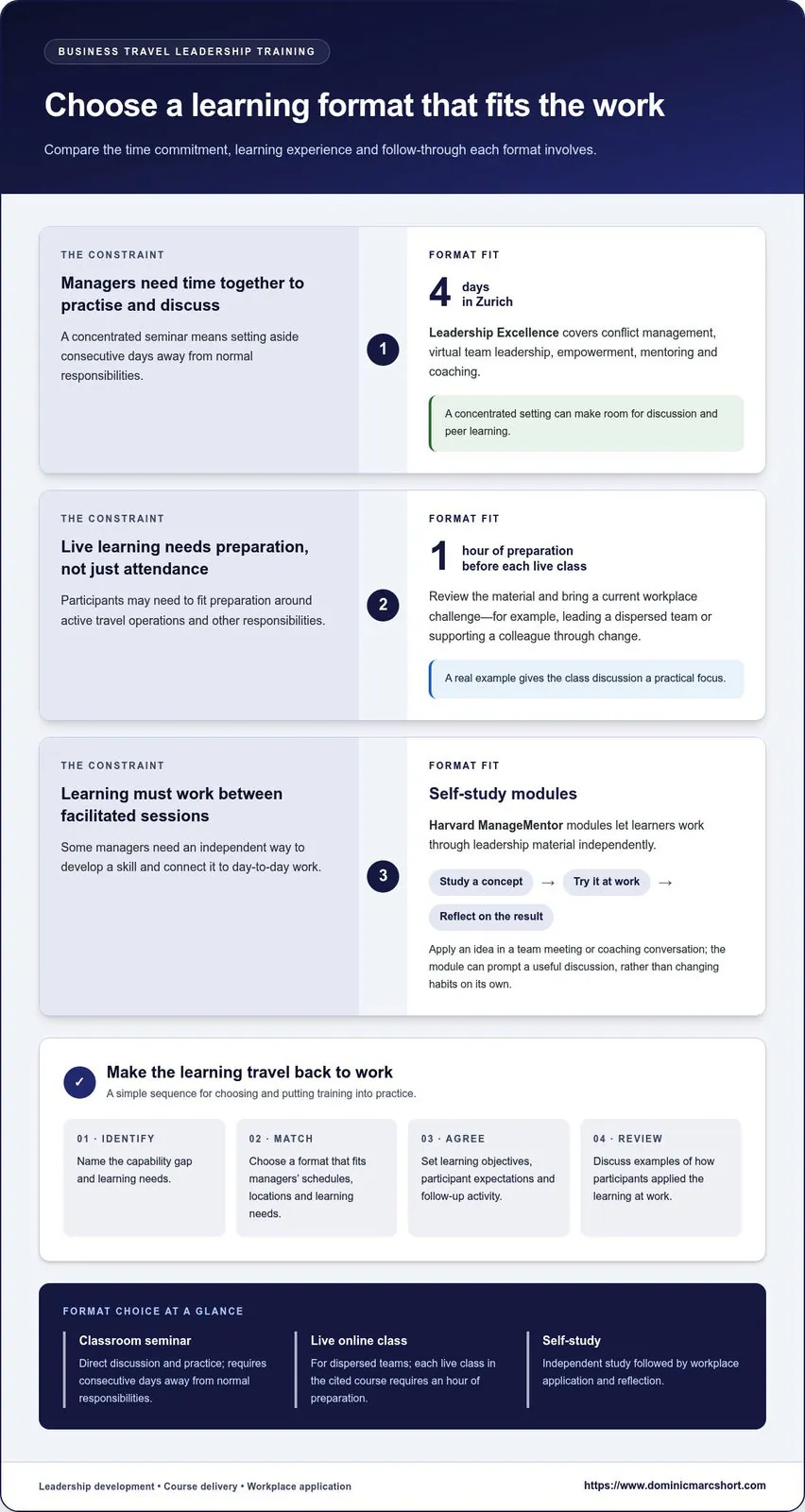
Travel leadership is about more than keeping journeys on schedule. Business travel leadership training covers practical management skills such as conflict management, leading virtual teams, and using mentoring and coaching to develop people. One professional leadership seminar lasts four days, while some live-class courses require one hour of preparation before each class.
Managers know that travel decisions affect budgets, employees and business relationships. The challenge is balancing these demands while giving teams clear direction, handling disagreement constructively and keeping work aligned with wider priorities.
This guide explains the leadership and management skills training can cover, how different formats work and what affects study time. It also looks at who these programmes suit and when structured training or targeted management consulting from Dominic Marc Short - Independent Consultant may be more useful for your organisation.
Table of Contents
- Travel business leadership and management skills
- Course delivery and study duration
- Leadership roles and strategic thinking
- Instructor experience
- Intended participants
- Dominic Marc Short - Independent Consultant: Business Travel Management Consulting
Travel business leadership and management skills
Business travel leadership training should connect people management with the daily decisions behind a corporate travel programme. A manager may need to resolve a booking problem, guide a supplier review and support an employee facing a disrupted journey, while keeping policy and business priorities in view.
Conflict management is a practical capability covered by leadership programmes. Managers can practise separating the issue from the people involved, hearing each perspective and agreeing on a clear next step. In a travel team, that might mean resolving tension between a booker focused on traveller convenience and a finance colleague focused on expense controls.
Reservation management and troubleshooting develop operational knowledge. A useful exercise follows a booking from request to return: understand the traveller’s needs, check that the itinerary follows policy, record approval, and clarify who handles changes or cancellations. Leaders should also review recurring issues, such as incomplete traveller details, to improve the process instead of repeatedly firefighting.
Strategic sourcing and vendor management call for a different perspective. Managers can compare suppliers against agreed service needs, process requirements and programme objectives, then set clear review measures. The aim is not simply to choose the lowest-cost option, but to understand how supplier performance supports travellers and the organisation.
Companies can assess the return on business travel training by setting a baseline before training and tracking relevant indicators, such as booking-policy compliance, resolution time, traveller feedback and repeat process errors. Compare results over a defined review period, and consider whether changes plausibly relate to the learning rather than treating every shift as proof of impact.
Harvard ManageMentor self-study modules can help managers develop skills between facilitated sessions. A manager might study a relevant topic, note one technique, then apply it in a team discussion or supplier review. This short cycle turns knowledge into practice without assuming a course alone will change working habits.
Stress management and work-life balance are also part of the leadership skill set. Leaders can review workload distribution, define escalation routes for urgent travel issues and make handovers clear before leave. Clear ownership helps teams respond calmly instead of turning every disruption into an all-hands event.
What Swiss travel, expense, and duty-of-care rules should business travel leaders know? They should build policy around the organisation’s approval process, expense documentation and traveller-support responsibilities, while aligning it with applicable Swiss requirements. Keep those rules accessible and explain who acts before, during and after a journey.
In Switzerland, managers can consider leadership seminars or specialist learning alongside business travel management consulting. The right option depends on whether the priority is personal development or improving the travel programme.
What are the best business travel management courses in Switzerland? The best fit depends on the learner’s role and objectives; the four-day Leadership Excellence seminar covers conflict management, virtual team leadership, mentoring and coaching, and requires management experience.
To create a business travel policy for Swiss employees, define approval steps, booking expectations, expense records and support responsibilities. Test the draft against a typical journey and a disruption scenario, then review it with the teams who will use it so the instructions work in practice.
Course delivery and study duration
Course format affects how managers fit learning around live travel operations. Options include classroom seminars, live online sessions and self-study, each offering a different balance of discussion, flexibility and preparation. For Swiss teams, choose a format that reflects participants’ locations, working patterns and opportunities to practise together.
The Leadership Excellence seminar in Zurich lasts four days. Its programme includes virtual team leadership, empowerment, mentoring and coaching, alongside conflict management. A concentrated seminar can make room for discussion and peer learning, while asking participants to set aside several consecutive days away from normal responsibilities.
Live-class study can extend beyond the scheduled session. This course requires an hour of preparation before each live class. Participants can review material and identify a current workplace challenge, such as leading a dispersed team or supporting a colleague through change. Bringing a real example gives class discussion a practical focus.
Self-study offers another format. Harvard ManageMentor modules let learners work through leadership material independently, then apply an idea in a team meeting or coaching conversation. The value comes from completing a learning cycle: study a concept, try it at work and reflect on the result. A module is not a magic wand, but it can prompt a useful conversation.
To choose and implement business travel leadership training, Swiss companies can start by identifying the capability gap, then match the course format to managers’ schedules, locations and learning needs. Before launch, agree on the learning objectives, participant expectations and follow-up activity. After delivery, review examples of workplace application with participants.
For teams spread across Swiss offices, live online sessions can reduce travel between locations, while face-to-face meetings enable direct discussion and practice. A blended format can combine independent preparation with facilitated sessions. The right design depends on whether the priority is shared understanding, individual reflection or practice with colleagues.
Study time depends on the learning design. A four-day seminar provides an intensive block; live classes add preparation before each session, while self-study can be scheduled around work. Managers should account for both formal learning and the time needed to apply new approaches in meetings and team decisions.
To make implementation concrete, assign each participant one workplace experiment after a session. For example, a manager might use a coaching question in a one-to-one meeting, then note the response and discuss the outcome with a peer. For support shaping a practical programme around business travel operations, discuss your training priorities with an adviser.
The Leadership Excellence seminar in Zurich is 4 days long, while each live class requires 1 hour of pre-work; managers can plan cover for both commitments.
Leadership roles and strategic thinking
Travel managers connect operational decisions with the organisation’s wider direction. Their responsibilities can include translating business priorities into travel choices, coordinating stakeholders and explaining trade-offs to senior leaders. For example, a team supporting market expansion may need travel plans that enable customer meetings and local partner discussions, not simply efficient booking processing.
Strategic thinking starts with identifying what leadership travel needs to achieve. Priorities may include market expansion, customer retention, employee engagement, innovation or organisational alignment. A manager can then assess each proposed journey against its purpose, intended participants and expected business contribution. This makes approval discussions more focused than debating travel in the abstract.
Site visits give senior leaders direct contact with regional offices, customer sites and international partners. A visit can demonstrate commitment and create space for frank discussion of local challenges. For example, a leader meeting a regional team can learn where global processes create friction, then use those observations to improve alignment with organisational goals.
Direct exposure can also inform decision-making. Leaders who experience customer needs, market conditions, competitor strategies and local business climates may identify opportunities that are less visible in reports. A structured visit should have a clear purpose, relevant meetings and a follow-up discussion that turns observations into decisions. Otherwise, a busy itinerary risks becoming a tour with excellent coffee and few conclusions.
Corporate travel management courses focus on programme operations, supplier relationships and travel-specific decisions. Executive leadership programmes develop broader capabilities, such as strategic judgement and leading teams. Managers can choose based on whether their goal is deeper travel expertise, wider organisational responsibility or a combination of both.
Leadership development helps travel professionals move from managing processes to influencing decisions. A manager preparing for a broader role can practise presenting options, explaining operational consequences and connecting recommendations to corporate priorities. Instead of reporting booking patterns alone, for example, they might explain how travel activity supports customer retention or employee engagement.
A practical approach is to turn each strategic priority into a decision framework. First, define the intended outcome. Next, identify which journeys, meetings or site visits support it. Then agree who owns the decision and how leaders will review what they learn. This gives travel operations a clear role in business planning instead of treating it as a separate administrative stream.
Career opportunities can follow when travel managers demonstrate operational knowledge and sound judgement. They may contribute to transformation projects, advise on organisational alignment or support leaders working across regions. Strong strategic thinking combines evidence from the travel programme with human insight from employees, customers and partners.
Instructor experience
Jennifer Steinke’s career spans over 30 years in the corporate travel industry. That experience gives learners a practical reference point for considering how travel programmes operate, how teams work together and where leadership decisions affect day-to-day delivery. For participants, the useful question is how an instructor turns that knowledge into clear learning, not simply how long they have worked.
Look for a connection between an instructor’s experience and the situations managers face. A discussion about supplier relationships, for example, should help learners examine priorities, communicate expectations and assess performance. Participants can test decisions against a realistic scenario instead of leaving with abstract advice and a notebook full of good intentions.
Relevant experience can also enrich discussion among participants. One manager might bring a challenge involving a dispersed team; another may describe a difficult change to booking processes. An instructor can help the group identify the underlying leadership issue, compare possible responses and draw lessons that apply across organisations.
To assess teaching quality, consider whether examples are explained in a way participants can use. A strong learning conversation might move from a situation to the decision made, its consequences and, finally, an alternative approach. This helps learners understand what happened and how they could develop their own response.
Experience should support current learning objectives, not dominate the room. In a practical exercise, an instructor might invite participants to analyse a travel-team disagreement, identify each stakeholder’s concern and propose a constructive next step. The value lies in the reasoning and feedback, not a long list of war stories, however entertaining the airport anecdotes.
Participants can make better use of an instructor’s expertise by arriving with a specific workplace question. A manager might bring a challenge about aligning travel operations with organisational priorities. They can compare the instructor’s perspective with their own context, identify one approach to test and reflect on the result after the session.
Jennifer Steinke’s corporate travel background is a relevant reference point for learners assessing instructor experience. Pair industry knowledge with clear explanations, useful discussion and opportunities to apply ideas. This helps managers judge whether a course supports their development while keeping the focus on skills they can use in their organisation.
Flow coaching offers another way to consider how experience supports learning: it creates an environment and provides subtle direction so learners can work things out for themselves rather than rely on detailed instructions. In this approach, the instructor does not supply every answer, but makes room for learners to explore ideas and reach their own understanding. This keeps attention on the learner’s thinking while retaining the instructor’s guidance. It also complements the practical emphasis above: experience can shape the setting and direction of a learning conversation without taking over the decisions participants need to examine. Learning comes through participation, not instruction alone.
Intended participants
The Leadership Excellence seminar is intended for people with management experience. Its audience includes executives, lower-management leaders, entrepreneurs, consultants and supervisory board members. This range brings different responsibilities into the room, but every participant should be ready to reflect on how they lead people and make decisions.
For a travel manager, the programme may suit someone moving from operational coordination towards broader responsibility. A manager who now leads colleagues across locations, for example, may want to strengthen delegation, communication and team development. Someone without management experience may benefit from foundational learning before taking a programme with that prerequisite.
Executives can use leadership development to examine how their priorities reach teams and influence organisational choices. A practical exercise might ask an executive to explain a change in travel processes, identify affected stakeholders and plan how to address concerns. Lower-management participants can explore the same change from the perspective of day-to-day implementation and team support.
Entrepreneurs may value structured reflection on how they set direction, assign responsibilities and build working relationships. Consultants can apply leadership concepts when facilitating client discussions or guiding a project team. Supervisory board members may focus on oversight, strategic questions and how leaders communicate progress. These different perspectives can enrich peer discussion when examples remain relevant to participants’ work.
Before enrolling, match the course objectives to your current role or the one you want to take on. Consider these questions:
- Does the programme address a current leadership challenge, such as delegation or change?
- Will the exercises relate to your team, organisation or client responsibilities?
- Can you set aside time to apply and reflect on the learning after the sessions?
Coaching and mentoring can help managers develop their approach through reflection and conversation. A participant might bring a real team challenge, consider different responses and decide what to try next. Consulting serves a different need: it focuses on organisational or programme questions, not solely on individual development.
A certificate may record completion, but it does not by itself show how someone applies leadership skills at work. Consider the learning activities, their relevance to your role and the opportunities to practise. The best fit is a programme whose expectations match your experience and responsibilities, not simply the one with the most impressive-sounding title.
For Swiss organisations, selecting participants from executive and operational roles can help connect strategic intent with practical implementation. Agree on each person’s learning goal before enrolment, then give them a suitable opportunity to apply an idea in their own setting. This makes attendance a deliberate development step rather than another diary entry.
Dominic Marc Short - Independent Consultant: Business Travel Management Consulting
Dominic Marc Short - Independent Consultant provides Business Travel Management Consulting for organisations reviewing how their travel programme works in practice. This support is useful when leadership development reveals wider operational questions, such as unclear processes, fragmented travel arrangements or the need to align programme decisions with business priorities.
The work can map current processes, identify opportunities to optimise them and shape a practical direction for travel management. Where broader organisational change is involved, Global Transformation Management and Change Management Communications Packages can support the transition. Meeting and Conference Organization can provide leadership teams with a structured setting for planning and discussion.
Training develops individual capability; consulting addresses organisational processes and priorities. To discuss your business travel management needs, contact Dominic Marc Short - Independent Consultant.
Put leadership learning into practice
Choose one leadership challenge that matters to your organisation and turn learning into a practical workplace action. Business travel leadership training can support individual development, while a wider programme review can help align processes, people and strategic priorities. Focus on what will make your team’s next decision clearer, not simply what looks neatest in a course catalogue.
Dominic Marc Short, Independent Consultant, offers Business Travel Management Consulting, Global Transformation Management and Meeting and Conference Organization. These services can support organisations improving a travel programme, managing transformation or planning business meetings and conferences.
A thoughtful first conversation can clarify whether your priority is individual development, programme change or both. Take the next step at a pace that suits your organisation, and give useful leadership ideas room to become lasting habits.
Build the next stage of your travel leadership with purpose and confidence.
Frequently Asked Questions
What does business travel leadership training cover?
Business travel leadership training covers the practices managers use to guide people and decisions within a travel programme. Some courses may use the GROW coaching structure: define the session goal, examine the current reality, explore options and agree on conclusions. This gives managers a practical framework for a one-to-one discussion, such as helping a team member work through a recurring booking challenge and identify a sensible next step.
What skills should leaders learn to manage business travel effectively?
Leaders benefit from coaching, adaptable communication and the ability to help teams solve problems independently. Neuro Linguistic Programming techniques focus on recognising that people may perceive situations differently, then adapting communication to the individual. Flow coaching takes another approach: create conditions for learning and offer subtle direction rather than prescribe every action. For example, a manager can guide a team through a process review with questions instead of a ready-made script.
Related articles
6 November 2026 · 15 min read
Virtual credit cards for business travel and spending controls
Explore how virtual credit cards for business travel control spending, simplify expenses and keep bookings moving with supplier checks and backup plans.

26 October 2026 · 14 min read
Business Travel Automation for Lower Costs and Smoother Workflows
See how optimizing business travel workflows cuts admin, controls costs and improves compliance, while keeping travellers supported and human judgement in play.

22 October 2026 · 15 min read
Blended Travel Policy: Rules for Business and Leisure Trips
Master your blended travel policy (business and leisure) with ease! Enjoy seamless trip approvals, clear expense rules, and happy, well-protected travellers.