Corporate communications for digital change: how to align teams
By Dominic Marc Short · 2 November 2026 · 14 min read

A polished company update can explain a digital transformation, but it cannot make people adopt it. Corporate communications for digital change must do more than share information: general corporate communications build awareness, while change communications help people understand, engage with and adopt new ways of working. This distinction matters because even the clearest announcement cannot answer every employee’s questions about what will change for them.
It is reasonable to expect communications to keep people informed. During a transformation, however, information needs to arrive at the right time, through useful channels, with room for honest feedback. Without that, silence can fuel speculation, and a new system can feel like one more thing to learn without a clear reason.
This article explains how the two types of communication differ, how to choose channels that support dialogue as well as updates, and how leaders can address resistance with clear, aligned messages. It also explores why communication should keep pace with the transformation, helping teams move from hearing about change to making it work in practice.
Table of Contents
- Are Change Comms and general Corporate Comms the same thing?
- Channels for organisational communications
- Digital transformation as an ongoing business process
- Organisational resistance and change management
- Leadership communication during digital transformation
- Dominic Marc Short - Independent Consultant: Business Travel Management Consulting
Are Change Comms and general Corporate Comms the same thing?
No. General corporate communications keep employees informed, while change communications focus on adoption and changed behaviour. During a transformation, this distinction helps teams move from hearing about a new system to using it.
Corporate Communication in Digital Transformation
Corporate communication during digital transformation is the planned exchange of information that helps employees and business partners understand organisational changes. It matters because replacing software can also reshape business models, processes and working relationships.
For Swiss SMEs, direct conversations can make it easier to gather questions, while large companies often need coordinated messages across teams and channels. In either case, involve employees and business partners in designing processes from the outset, especially when restructuring a business model.
When communication platforms handle employee information, organisations should set clear data-handling practices and explain how information is used. Transparency helps employees know what to expect when using a new system or channel.
Goals of Change Communication
Change communication explains what is changing, why it matters and how people can take part. Its practical goals include building awareness, supporting adoption, addressing resistance and maintaining constructive relationships during the transition.
Those goals differ from routine updates, which mainly provide ongoing information. Effective corporate communications for digital change also invite questions and use employee feedback to improve messages and support. Gallup reported that 20 percent of employees worldwide felt engaged at work in 2021, a reminder that communication takes place within real workplace cultures.
Measure effectiveness through communication analytics and employee feedback. For example, assess whether employees understand the change, can find relevant guidance and know how to raise issues through available channels.
Communicating a Change Initiative
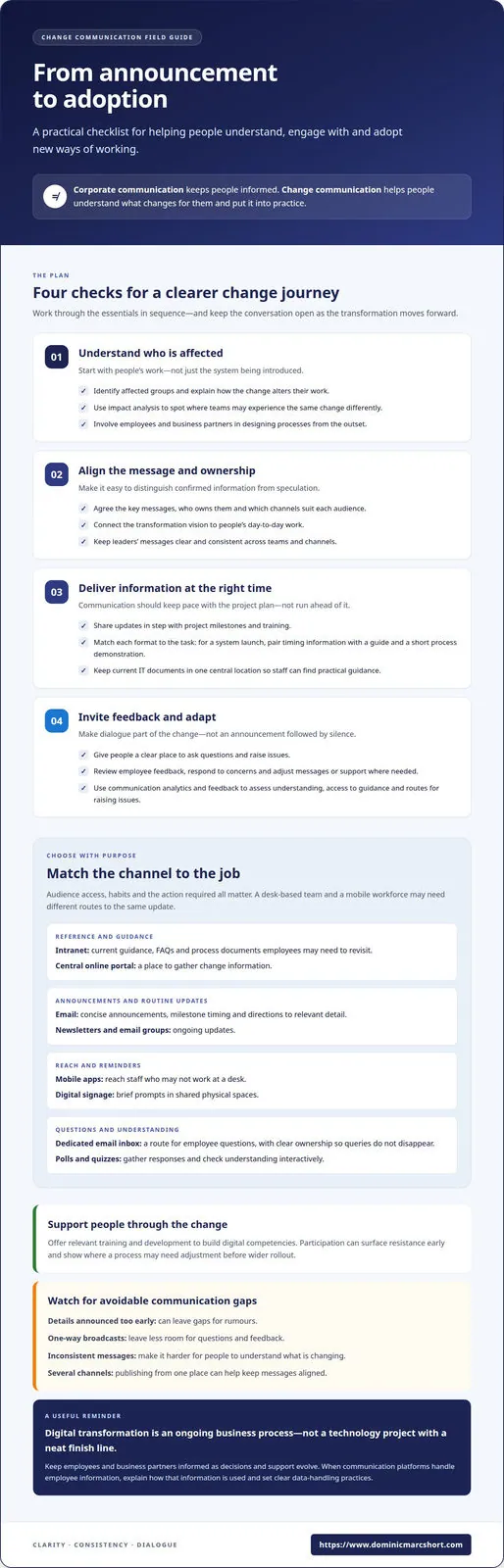
Communicating an initiative means aligning messages with the transformation plan, its audiences and the support each group needs. A clear sequence helps employees distinguish confirmed information from speculation.
- Identify affected groups and explain how the change alters their work.
- Agree on key messages, owners and suitable channels.
- Share information in step with project milestones and training.
- Invite questions, review feedback and adapt communications.
Common risks include announcing details before they are ready, relying on one-way broadcasts and sending inconsistent messages. Detailed communications should keep pace with the project plan, rather than run ahead and leave gaps for rumours.
Employee Involvement and Support
Employee involvement gives affected people a way to shape, question and practise new ways of working. Feedback can reveal resistance early, and participation can show where a process needs adjustment before wider rollout.
For example, administrative and operational teams may experience the same change differently. An impact analysis can identify those differences, while training and development help employees build digital competencies. Keeping current IT documents in one central location gives staff a practical reference when questions arise.
Change communications work best as dialogue, not a cheerful announcement followed by silence. Provide a clear place to ask questions, respond to concerns, and keep employees and business partners informed as decisions and support evolve.
Channels for organisational communications
Choose channels according to the message, audience and action required. A channel mix based on convenience alone can leave important updates buried, especially when employees use different tools throughout the workday.
Email suits concise announcements and links to detailed guidance; an intranet can hold reference material employees need to revisit. Newsletters and email groups work for routine updates, while digital signage can surface brief reminders in shared workplaces. Each channel serves a different purpose, so repeating identical content everywhere is rarely the clearest approach.
For a change initiative, match the format to the task. A system launch might need an intranet guide, an email explaining the timing, and a short demonstration of a key process. A central online portal can gather change information, while a dedicated email inbox gives employees a way to send questions. Clear ownership prevents queries from disappearing into a crowded mailbox.
- Intranet: store current guidance, FAQs and process documents.
- Email: announce milestones and direct employees to relevant detail.
- Mobile apps: reach staff who may not work at a desk.
- Digital signage: display concise prompts in shared physical spaces.
- Polls and quizzes: gather responses and check understanding interactively.
WashREIT reported that people interacted with content on its mobile app up to 15 times more in some instances than with email. Treat that as an example, not a universal forecast: the useful channel depends on employees’ access, habits and the task at hand. A desk-based team and a mobile workforce may need different routes to the same update.
When using several channels, publishing from one place can help keep messages aligned across an intranet, email, mobile apps and digital signage. Before choosing tools, assess whether they support the communication objective, can scale to the audience and integrate with existing systems. An announcement may need broad reach, for instance, while a process change needs searchable instructions and a way to raise specific questions.
Then review performance against each channel’s purpose. Track whether employees open or view updates, use linked guidance, complete interactive checks or submit recurring questions. These signals can identify a message that needs clarification or a channel that is missing its intended audience. Pair analytics with employee feedback: a high view count alone does not show whether people understood what to do next.
A coherent channel plan takes coordination. Explore support for change communications planning when several channels need to work together throughout a transformation.
Digital transformation as an ongoing business process
A digital transformation does not end when a new platform goes live. It changes how a company operates, serves customers and works with partners, so communications must evolve alongside the business.
Consider a Swiss company introducing a digital customer service platform. The initial launch may change how staff handle enquiries, while later adjustments may reshape customer journeys, team responsibilities or service processes. Treating the platform as the whole transformation overlooks these connected changes. Digital transformation involves redesigning business models, not simply updating IT systems or automating existing tasks.
The work also extends beyond company boundaries. A new customer portal, for example, can affect customers, suppliers and internal teams who rely on the same information. Communications should explain how the change affects each relationship as the programme develops. A launch-day message may no longer answer questions that arise during later process changes.
A fixed project plan can organise delivery, but it does not make transformation a one-off event. Technology, customer expectations and business priorities continue to evolve. Companies that treat digital transformation as a single technology change may face the same challenge again within five to ten years. The practical response is to build communication into ongoing business planning, rather than reserve it for launch announcements.
This approach changes what communicators need to do. They must translate evolving business priorities into clear information, then update content as processes change. Big Data also affects professional communications, not just production or data-led business models. It can help organisations distinguish themselves in competitive environments while changing the communicator’s role. Communication teams need the tools and skills to understand algorithms alongside traditional approaches.
For example, if a company introduces data-driven customer recommendations, staff need more than a launch notice. They need to understand how the new process affects their work, what information they can explain to customers and where to find current guidance. Communications should make complex changes understandable without suggesting that a new tool solves every operational issue.
Review communications as the transformation moves through distinct business stages:
- Explore: explain the business need and the changes under consideration.
- Implement: clarify what is changing now and how teams can adapt.
- Refine: share what has changed again, using current operational insights.
- Embed: keep information aligned with established processes and future improvements.
Analytics can show whether communications support the programme’s changing needs. Compare employee questions and content engagement with the specific updates being shared. If questions repeatedly concern a changed process, revise the explanation. This makes communication part of transformation governance, rather than a final task after technology decisions are made.
Organisational resistance and change management
Resistance often signals a practical concern, not a refusal to modernise. Employees may worry, for example, that new workflow software will add steps, remove familiar controls or make customer issues harder to resolve. Treating these concerns as useful information helps leaders distinguish a skills gap from unclear responsibilities or a process that needs redesign.
Begin with a change impact analysis. Map which roles, teams and work locations will experience altered tasks, decisions or systems. Administrative staff entering information and operational staff using it to serve customers may be affected differently by the same platform. This analysis lets managers tailor explanations and support to actual working conditions, rather than send everyone the same generic message.
Then make resistance discussable. Explain what is changing, what remains stable and where decisions are still being developed. If a team fears automation will remove a familiar task, describe how responsibilities may shift and invite specific questions. Do not present a planned benefit as an immediate personal gain if employees still need training or process changes to realise it.
Change agent networks can provide a useful link between employees and programme leaders. Colleagues close to daily work can surface sentiment, identify recurring questions and help rebuild trust during the transition. Give these agents a defined role: collect concerns, share accurate updates and escalate issues that require a decision. Do not expect them to improvise answers to unresolved technical or staffing questions.
Practical support makes communication credible. If a new system changes how staff complete a task, pair the explanation with relevant training and development opportunities. Provide worked examples, such as how to correct an entry or route a customer request. Keep current IT documents in a central location so employees can find guidance when the task arises, not only during a launch meeting.
Use feedback to adjust support, not merely to demonstrate that consultation took place. Review recurring questions, note which teams raise them, and respond with a clearer explanation, a training update or a process review. If employees report that a new approval step delays work, investigate the workflow and explain what happens next. Closing the loop shows that participation can inform action.
- Listen: gather concerns through team discussions and change agents.
- Interpret: connect each concern to its likely impact or information gap.
- Respond: provide relevant guidance, training or a clear decision.
- Revisit: check whether the issue remains after the response.
This approach turns employee resistance into evidence for change management. Leaders can address real barriers early, while employees see how their input shapes the transition.
Leadership communication during digital transformation
Leaders engage employees by explaining the change clearly, aligning messages and making dialogue part of the work. They address resistance by listening to concerns and responding with practical information, rather than simply repeating the vision.
Leadership Engagement with Employees
Leadership engagement means connecting the transformation’s purpose with employees’ work and inviting their active participation. This matters because teams need to understand not only what is changing, but why the direction makes sense.
A compelling, high-level change story matters. Digital transformations are 5.8 times more likely to succeed when CEOs communicate one. Senior leaders sharing aligned messages makes transformations 6.3 times more likely to succeed. These findings underline a practical point: employees should hear a consistent explanation from leaders, not competing versions from different departments.
Consistency does not require identical speeches. A CEO can explain the strategic case, while a team manager explains what it means for local workflows. Both should connect their message to the same priorities, such as improving customer service or simplifying a process. Leaders can also make the story credible by describing what they are learning as implementation progresses.
Addressing Resistance to Digital Change
Addressing resistance means treating employee concerns as information leaders need to understand and answer. This matters because silence, uncertainty or conflicting explanations can weaken confidence in the transformation.
Make questions visible and respond without dismissing concerns. If employees ask whether a new digital process will change customer responsibilities, leaders should explain the known impact and identify what remains under review. Communications should be transparent with employees, customers and partners about upcoming changes, while detailed updates keep pace with the project plan.
Timing matters. Sending a detailed announcement before dependable information is available can prompt speculation and gossip. Share the confirmed purpose early, then release operational details when decisions and support are ready. Make each update relevant, timely and easy for its intended audience to access.
Leadership communication should also reflect how transformation work happens. Hierarchical, one-way announcements may not suit programmes built around iteration, agility and teamwork. Leaders can provide regular digital updates alongside in-person conversations, then make space for teams to raise issues. McKinsey found that leaders using remote and digital communications to convey a transformation vision had a success rate three times greater than leaders using in-person or traditional channels. This supports a mixed approach, not a rule that digital channels always work better.
For example, a leadership update can state the next milestone, explain its business purpose and show employees where to raise questions. Managers can then discuss effects on their teams, while executives return to the shared vision in later updates. Repetition is useful when it adds context, not when it merely recycles slogans.
Strong leadership communication brings strategy, timing and employee experience together. A clear story gives direction; aligned messages prevent confusion; open dialogue gives leaders a way to hear what needs attention. Explore leadership support for digital transformation
Dominic Marc Short - Independent Consultant: Business Travel Management Consulting
Dominic Marc Short, Independent Consultant, supports organisations managing transformation and its communications. When digital change affects business travel processes, Business Travel Management Consulting can help assess how those processes fit the wider programme. Global Transformation Management supports broader organisational change, while Change Management Communications Packages help structure communication around the people affected.
Consider this support when a technology rollout also changes workflows, responsibilities or how teams coordinate. Introducing a travel management system, for example, can involve both process decisions and clear communications to help employees adopt new ways of working. The right focus depends on the transformation’s scope and the business processes involved.
To discuss your organisation’s needs, contact Dominic Marc Short - Independent Consultant.
Make the next change easier to lead
The next transformation can begin before a new platform is selected. Start by asking what your organisation wants people to do differently, and what leaders must make possible for that change to take hold. That conversation can reveal whether teams need clearer priorities, stronger coordination or a more deliberate approach to corporate communications for digital change.
Turn the answer into a leadership commitment: give someone responsibility for keeping the change connected to business decisions, employee experience and the organisation’s evolving needs. This helps communication remain part of the work, rather than a message prepared after important choices have already been made. It also gives teams a clearer foundation for responding as conditions shift.
Digital change is demanding, but it can also create fresh opportunities to work better together. A thoughtful next step can make the way forward more manageable.
Bring your next transformation into focus, one considered decision at a time.
Frequently Asked Questions
But how can communication be realigned?
Realign communication by comparing what leaders intend to convey with what employees need to understand and do. Review recent messages for conflicting terminology, unclear ownership or gaps between policy and daily practice. If managers describe a new approval process differently, for example, agree on one shared explanation and give teams a way to flag local exceptions. This keeps the central message consistent without pretending every role faces identical changes.
What does digital transformation really mean?
Digital transformation means using digital capabilities to reshape how an organisation creates value, not simply replacing a paper form with an online one. A company might, for example, connect customer enquiries, service delivery and operational data so teams can respond differently. Transformation involves choices about processes, responsibilities and customer relationships. A new tool may enable that shift, but the tool alone is not the transformation.
Which communication channels work best for communicating digital transformation to employees?
The best channels are those employees can access and use for the task at hand. A short update may suit an asynchronous channel, while a sensitive change affecting roles may need a manager-led discussion with time for questions. Keep a reliable source of current information available, and offer a feedback route employees can use privately or openly. Check comprehension through real work scenarios, not views alone.
How should companies create a digital transformation communication strategy?
Build the strategy around audience needs, decision points and the actions each message should support. Create an audience map showing affected roles, their key concerns and who can answer them. Then assign message owners, agree on terminology, set a rhythm tied to programme milestones and define how feedback will be reviewed. For example, recurring questions about a new workflow can prompt a revised manager briefing before the next rollout stage.
Related articles

5 November 2026 · 14 min read
Corporate Event Planning Services in Switzerland for Teams
See how corporate event planning services in Switzerland bring venues, suppliers, guest travel and event-day delivery together for a smooth, engaging team event.

29 October 2026 · 13 min read
Travel management masterclass for corporate travel teams
Explore a travel management masterclass for corporate teams: practical guidance on policy, costs, suppliers and traveller safety in Swiss workplaces.

3 November 2026 · 12 min read
Corporate Meeting Planning: Roles and Setup Guide
Explore corporate meeting planning services: set clear objectives, assign roles, choose venues and plan follow-up for productive meetings with confidence.