Travel management masterclass for corporate travel teams
By Dominic Marc Short · 29 October 2026 · 13 min read

A travel management masterclass is most useful for people who plan, oversee or improve business travel, including travel managers, procurement and finance professionals, and team leaders who influence travel policy. It’s especially relevant when processes need clearer ownership or stronger alignment with organisational priorities. You don’t need to be a travel specialist to benefit; understanding how decisions affect travellers, budgets and operations is a good starting point.
Useful training should connect strategic principles with the realities of day-to-day work. Short courses may run from a few days to a week, while more in-depth training can span several weeks to several months. Choose a format that suits your role, experience and available time. Even a strong learning plan needs to fit around your working week.
This guide explains who benefits most, what effective training should cover and how to judge whether a course can improve travel management in practice. It also considers practical learning, cost control and applying new ideas in a Swiss business context, without unnecessary jargon.
Table of Contents
- Why take a travel manager training course?
- Travel policies and regulatory compliance
- Cost management and business travel efficiency
- Supplier relationships and negotiation
- Traveller safety and duty of care
- Dominic Marc Short - Independent Consultant: Business Travel Management Consulting
Why take a travel manager training course?
A travel manager course can help turn travel data into clearer decisions about policy, performance and spending. A well-chosen travel management masterclass also connects industry changes with the practical needs of your organisation.
Performance Metrics and Cost-Saving Analysis
Start with measures that show both cost and service: booking channel use, policy exceptions, average trip costs and traveller feedback. Compare like with like, such as trips on similar routes or with similar purposes, and note the period covered. Then investigate why results changed. A lower fare is not necessarily a better outcome if it leads to more itinerary changes or less flexibility for essential travel.
Market Trends and Travel Data Analytics
Market analysis helps travel teams consider how changes in travel and tourism could affect business trips. Training should teach participants to interpret booking, spending and traveller data, not just produce charts. For example, compare demand on a route across reporting periods, then assess whether booking patterns reflect business priorities or reveal gaps in policy. Travel agencies and suppliers can also provide context for market changes.
Swiss and international programmes may differ in focus and delivery. Compare each course with your organisation’s travel patterns and operating context. An international programme may provide a broader global perspective, while the best fit is ultimately the one whose material can inform decisions your team will use.
Options in Switzerland include short courses, longer professional programmes, online learning and training arranged for an organisation. Shorter courses may last a few days to a week; more in-depth study can take several weeks or several months. Some degree or certification courses run across an entire year, often part-time.
Before choosing a course, review the syllabus, trainer qualifications, former participants’ reviews and learning formats. Look for practical work, such as workshops or case studies, alongside theory. If cost control is a priority, check that the programme covers negotiation, cost management and booking technologies.
Accreditation and certificates are not the same. A course may award a completion certificate, while recognition by a professional body can indicate quality and relevance. Read the course description to see what credential participants receive and which organisation provides any recognition. These details clarify what you can demonstrate after completing the course.
Registration usually involves choosing a programme and format, reviewing entry requirements and completing the organiser’s enrolment process. Before enrolling, check that the timetable fits your work commitments and the syllabus covers your goals. Identify one travel-management challenge you want to address, so you can apply the learning from the outset.
Travel policies and regulatory compliance
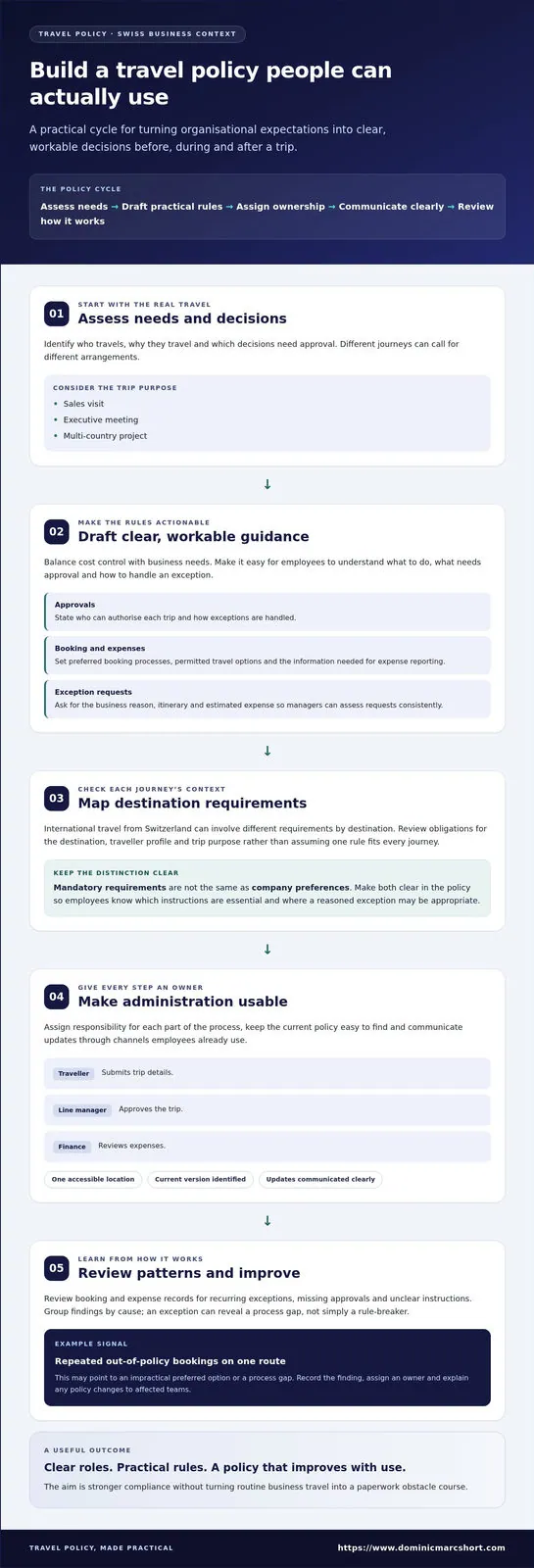
A corporate travel policy turns organisational expectations into decisions employees can follow before, during and after a trip. International travel from Switzerland can involve different destination requirements, so policy development should connect internal approval steps with current responsibilities specific to each trip.
Begin by identifying who travels, why they travel and which decisions require approval. A sales visit, an executive meeting and a multi-country project may need different arrangements. Specify who can authorise each trip, how to handle exceptions, which booking channels employees should use and where to find guidance. Clear roles reduce uncertainty for travellers and administrators.
A policy should balance cost control with business needs. Define preferred booking processes, permitted travel options, approval thresholds and the information required for expense reporting. For example, before booking an exception, a traveller can provide the business reason, itinerary and estimated expense. A clear process helps managers assess comparable requests consistently instead of relying on rushed email exchanges.
Review regulatory requirements by destination rather than assuming one rule applies to every journey. Map relevant obligations by destination, traveller profile and trip purpose, then assign responsibility for monitoring changes. Distinguish mandatory requirements from company preferences in the policy. This helps employees recognise which instructions are essential and where a reasoned exception may be appropriate.
Good administration makes a written policy usable. Assign an owner to each step, such as the traveller submitting details, the line manager approving the trip and finance reviewing expenses. Keep the current policy in one accessible location, identify its version and communicate updates through channels employees already use. A hard-to-find policy cannot guide a short-notice booking.
To assess compliance, review booking and expense records for recurring exceptions, missing approvals and unclear instructions. Group findings by cause rather than treating every exception as misconduct. Repeated out-of-policy bookings on one route, for instance, may point to a process gap or an impractical preferred option. Record the finding, assign an owner to address it and explain policy changes to affected teams.
Training should present policy development as an ongoing cycle: assess needs, draft practical rules, assign administrative ownership, communicate clearly and review how the policy works. This gives travel managers a structured way to improve compliance without turning routine business travel into a paperwork obstacle course.
If policy design needs to connect with wider programme improvements, business travel management consulting can help organisations assess their processes and shape practical changes.
Refresh training when review findings reveal recurring questions or procedures change, and give employees a clear way to raise concerns. Jennifer Steinke has over 30 years of experience in the corporate travel industry, bringing extensive experience to travel education.
The Introduction to Travel Agencies module is estimated to take 2 hours to complete, offering a focused learning option for those building foundational knowledge.
Cost management and business travel efficiency
Effective business travel management starts with the full journey, not just the ticket price. Total trip costs can include transport, accommodation, local transfers, change fees and administration. For a Swiss organisation, recording expenses in CHF and identifying foreign-currency transactions makes comparisons easier. The basics are to understand why travel is needed, make booking decisions consistently and assess the overall value delivered.
Build a cost review around your organisation’s actual travel patterns. Group trips by destination, purpose and booking channel, then compare similar journeys rather than treating every itinerary as equivalent. A flexible ticket, for example, may cost more upfront but suit a meeting whose end time could change. A cheaper fare may prove less efficient if a schedule change adds work or disrupts an important client visit.
Efficiency also depends on how trips are planned. Consider whether travellers can combine nearby meetings, avoid unnecessary connections or take a suitable rail journey instead of flying. In Switzerland, rail may work well for some domestic journeys, depending on destination, timing and business needs. Agencies and travel suppliers can explain available arrangements, while the organisation weighs service needs against total trip costs.
Choose training that connects negotiation, cost management and booking technologies. These subjects should work together: negotiated terms matter only if booking processes make them usable, and booking tools are valuable when they support policy and reporting. A case study might ask participants to compare two itineraries, identify hidden costs and explain which option best serves the business purpose.
Sustainability adds another factor to business travel decisions. First ask whether a meeting requires travel, then consider remote participation, combined itineraries and lower-impact transport where suitable. A team attending several meetings in one city, for instance, could coordinate dates and travel together. Record the reasoning behind choices so sustainability goals inform planning rather than becoming a box-ticking exercise.
Measure efficiency through a consistent review cycle. First agree what the organisation wants to improve, such as booking compliance, trip administration or total expenditure. Then compare the same categories across reporting periods and investigate significant changes. Finally, assign an owner to each action, such as refining approval steps or improving access to booking information. This shows progress without mistaking a lower fare for the whole story.
Cost analysis should protect the purpose of travel, not simply reduce spending. When a trip supports a client relationship, project delivery or essential collaboration, weigh those outcomes alongside cost and operational effort. This balanced approach keeps business travel focused, efficient and useful to the organisation.
Supplier relationships and negotiation
A corporate travel programme relies on suppliers to deliver arrangements that meet business needs. Airlines, accommodation providers, rail operators and travel agencies can each affect itineraries, traveller experience and administration. Assess supplier relationships on more than headline rates: consider service consistency, booking processes, reporting quality and how well the arrangement supports your organisation’s travel patterns.
Before negotiating, build a clear picture of current demand. Group travel by route, destination, purpose and booking channel, then identify where supplier services are used most. Recurring journeys between Zurich and London, for example, may warrant a focused discussion about suitable schedules and booking arrangements. Reliable data gives both sides a practical basis for discussing value.
Set priorities before meeting a supplier. Decide which outcomes matter most, such as itinerary flexibility, clear service processes, accessible reporting or terms that support policy compliance. Separate essential requirements from preferences. If a proposed arrangement offers a lower fare but adds steps for travellers, discuss the operational impact as well as the financial terms. Effective negotiation weighs the complete business case.
A regular performance review turns expectations into action. Choose measures that reflect the agreement and your organisation’s priorities, such as booking accuracy, response quality, traveller feedback, reporting completeness and the handling of itinerary changes. Review specific examples with the supplier, such as a booking that needed correction, then agree what should improve and how to track progress.
Keep supplier relationships structured after reaching an agreement. Record service expectations, who owns each action and how to raise issues. A quarterly review, for example, can examine booking patterns, recurring exceptions and traveller feedback. Set a review schedule that suits the organisation’s travel volume and supplier arrangements, rather than adding meetings without a clear purpose.
Clear communication also supports strong supplier relationships. Share changes to travel requirements promptly, explain internal approval processes and give suppliers useful context when itineraries change. If a team shifts from individual visits to project-based group journeys, discuss the change before booking patterns become difficult to manage. This helps suppliers respond to actual demand and makes service discussions more constructive.
A travel management masterclass should include negotiation exercises and supplier scenarios that build practical judgement. Participants can practise preparing evidence, setting priorities, discussing service gaps and documenting agreed actions. Across the travel and tourism industry, supplier relationships work best when expectations are specific, performance is reviewed consistently and both parties understand what a successful arrangement means.
Traveller safety and duty of care
Build traveller safety into business travel operations from the outset, not after an itinerary is booked. When sending staff abroad, a Swiss organisation should identify foreseeable journey risks, traveller needs and the people responsible for decisions. A clear process tells employees where to find guidance and whom to contact if circumstances change.
Assess each trip by its destination, purpose, route and planned activities. A conference visit, for example, may require different transport and accommodation arrangements from a multi-site project. Record relevant considerations, such as late arrivals, ground transfers or travel between locations. This practical approach helps managers focus on the journey instead of treating every booking as identical.
Before departure, provide concise, trip-specific information. Include confirmed itinerary details, local transport arrangements, key internal contacts and steps for reporting a disruption. Ask travellers to review the information before leaving, and make sure managers know where the latest itinerary is stored. A useful briefing is easy to find on a phone, not buried in a long email chain.
During travel, define how updates and concerns pass between the traveller and the organisation. If a cancelled connection changes the arrival plan, for instance, the employee should know whom to notify and how to share the revised itinerary. Assign internal responsibility for receiving updates and escalating concerns. Clear ownership matters, especially when a journey involves several teams or locations.
A response process should explain what employees should do when an incident or disruption occurs. Specify the reporting channel, the information to provide and the internal roles responsible for coordinating next steps. A traveller reporting a missed connection, for example, can share their location, revised plans and immediate concern. Practical instructions reduce confusion without assuming every situation follows the same script.
Review the process after trips and incidents. Look for recurring problems, such as unclear transfer details or travellers not knowing where to report changes. Assign an owner to each improvement, then update briefings or procedures. This turns traveller feedback into operational learning and ensures the organisation’s commitment to safety informs real decisions.
Training should connect risk assessment, communication and response planning with realistic scenarios. Ask participants to work through a disrupted itinerary and identify who communicates, records updates and coordinates decisions. In corporate travel, this exercise makes duty of care a working practice rather than a phrase in an introduction.
Dominic Marc Short - Independent Consultant: Business Travel Management Consulting
Dominic Marc Short, Independent Consultant, offers Business Travel Management Consulting to help organisations turn travel priorities into practical programme improvements. It is a natural next step when training has clarified a challenge but your team needs support analysing processes, optimising operations or developing travel management solutions. The work connects policy, booking processes, payment solutions and digital transformation with your organisation’s objectives.
For wider organisational change, Global Transformation Management and Change Management Communications Packages can support the transition. Meeting and Conference Organization is relevant when business gatherings need structured planning. These services suit organisations seeking tailored consulting, not leisure travel bookings or emergency travel support.
Turn learning into your next practical step
Use a travel management masterclass as a starting point, then choose one priority to put into practice. You might clarify who owns a travel decision, improve how your team reviews supplier performance or make trip information easier for employees to use. A focused first step builds momentum without requiring you to redesign every process at once.
Before making a change, define what should work better for travellers and the organisation. Identify who needs to contribute, what information will guide the decision and how you’ll review its effect. This simple discipline turns new knowledge into a considered improvement, rather than another document waiting in a shared folder.
For a tailored discussion about your organisation’s business travel priorities, explore the consulting support available and choose a next step that fits your team.
Every well-managed programme starts with a clear decision. Choose your priority, bring the right people into the conversation and take the next step with confidence.
Frequently Asked Questions
Who should attend?
Travel managers, procurement and finance professionals, and corporate team leaders can all benefit. The training can also help employees taking on travel responsibilities from roles such as office management or operations. A finance colleague reviewing travel expenses, for example, can gain a broader view of how booking decisions affect reporting and traveller needs. Bring a real workplace challenge, such as unclear approval ownership, to connect learning with day-to-day responsibilities.
What topics are covered in a travel management masterclass?
A travel management masterclass may cover programme strategy, policy development, cost analysis, supplier negotiation, traveller safety and performance measurement. Practical exercises can help participants apply these topics, such as reviewing a sample programme and identifying where its processes create friction. Course content varies, so compare the syllabus with your role. Someone in procurement may prioritise negotiation, while a new travel manager may need a broad introduction to programme operations.
What career benefits can a travel management masterclass provide?
A masterclass can strengthen the practical skills used to manage corporate travel and explain decisions to colleagues. Participants may learn to analyse programme information, contribute to policy discussions and communicate with suppliers more effectively. An operations professional, for example, could use course exercises to prepare a structured recommendation for improving an internal booking process. These skills can support professional development and broader responsibility, though career progression depends on individual experience and workplace opportunities.
Related articles

5 November 2026 · 14 min read
Corporate Event Planning Services in Switzerland for Teams
See how corporate event planning services in Switzerland bring venues, suppliers, guest travel and event-day delivery together for a smooth, engaging team event.

2 November 2026 · 14 min read
Corporate communications for digital change: how to align teams
Corporate communications for digital change can build trust and adoption. Learn to align leaders, choose effective channels and help teams embrace new ways o...

28 October 2026 · 14 min read
Corporate travel sustainability strategy: How to cut travel emissions
Discover how a corporate travel sustainability strategy can cut emissions with smarter measurement, rail-first choices, practical targets and greener booking...