How to Choose a Keynote Speaker for an Event: A Practical Checklist
By Dominic Marc Short · 16 October 2026 · 14 min read

The most famous name on your shortlist may not be the right speaker for your event. Knowing how to choose a keynote speaker for an event starts with a more useful question: what should your audience think, feel or do differently afterwards? Reputation can help attract attention, but it does not guarantee that a speaker’s experience or message will suit your programme.
To make a sound choice, look for a speaker whose expertise and delivery fit the audience, support the event’s objectives and work within the practical arrangements. The right person should make sense both on stage and in the planning meeting.
This checklist will help you compare candidates on audience fit, relevant experience, content, delivery and logistics. It also covers how to prepare for the session and assess whether it achieved its purpose. With clear criteria, you can choose with confidence rather than relying on a glossy biography and crossed fingers.
Table of Contents
- How to choose a keynote speaker by starting with event outcomes
- How to assess a keynote speaker’s expertise and content
- How to compare keynote delivery style and audience fit
- Keynote speaker selection checklist: brief, format and logistics
- Choose a keynote speaker who can support the event from brief to delivery
How to choose a keynote speaker by starting with event outcomes
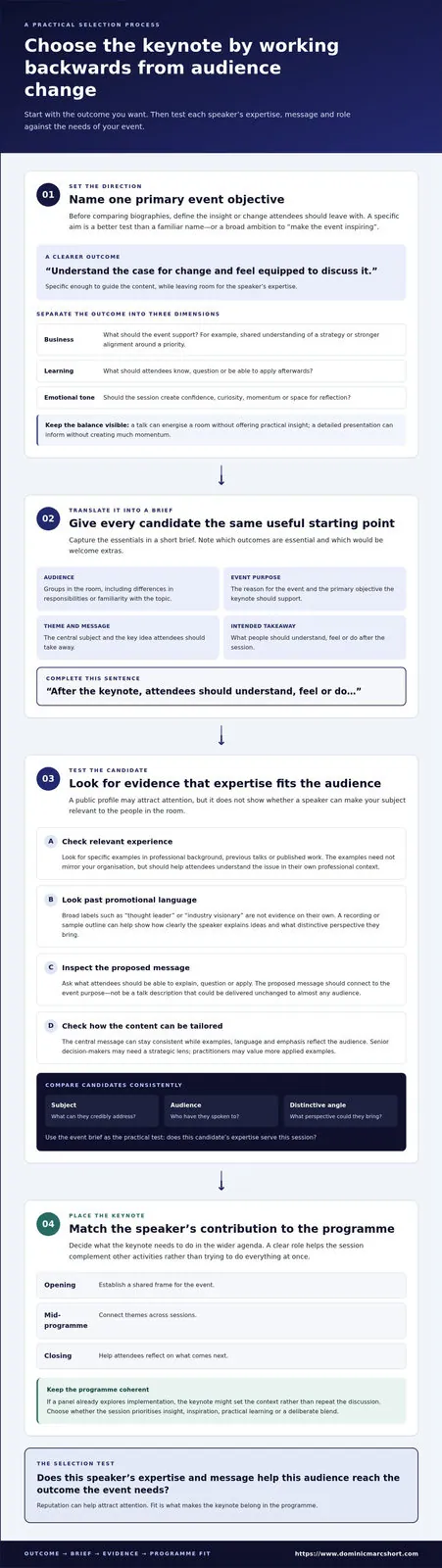
Before comparing biographies, write down the insight or change attendees should leave with. That gives your selection process direction and makes it easier to distinguish a strong fit from a polished profile. If you’re considering how to choose a keynote speaker for an event, begin with the result you want, not the name you recognise.
Set one primary objective. For example, an organisation introducing a new strategy might want attendees to understand why it matters and feel ready to discuss their role in it. That gives you a more useful test for candidate content than a broad aim such as “make the event inspiring”.
Then separate three dimensions that are often bundled together:
- Business outcomes: What should the event support, such as shared understanding of a strategy or stronger alignment around a priority?
- Audience learning: What should attendees know, question or be able to apply after the session?
- Emotional tone: Should the session create confidence, curiosity, momentum or space for reflection?
These dimensions can work together, but they are not interchangeable. A talk can energise a room without offering a practical insight, while a detailed presentation may inform an audience without creating much momentum. Name the intended balance so you can assess proposals against the event’s actual purpose.
Turn the event purpose into a clear speaker brief
Capture the event’s purpose, audience groups and central message in a short brief. Note which outcomes are essential and which would be welcome extras. Then complete this sentence: “After the keynote, attendees should understand, feel or do…” Be specific enough to guide the content while leaving room for the speaker’s expertise. For instance, “understand the case for change and feel equipped to discuss it” is clearer than “be motivated”.
A practical brief can fit on one page. Include the audience, event purpose, theme, primary objective and intended takeaway. Note any differences between audience groups, such as distinct responsibilities or levels of familiarity with the topic. This gives a speaker a useful starting point and helps you compare candidates on a consistent basis.
Match the keynote role to the programme
Decide what the keynote needs to do within the wider programme. An opening address may establish a shared frame; a mid-programme keynote can connect themes across sessions; a closing address can help attendees reflect on what comes next. A keynote is typically a central address, as outlined in What is a Keynote Speaker?, but its specific contribution should be clear in your agenda.
Choose whether the session should prioritise insight, inspiration, practical learning or a deliberate blend. Then distinguish it from the other activities. If a panel already explores implementation, for example, the keynote might set the context rather than repeat the discussion. A well-defined role keeps the programme coherent and gives the speaker a clear brief, rather than asking one session to do absolutely everything.
How to assess a keynote speaker’s expertise and content
Once your event brief is clear, assess each candidate against its subject and audience, not the size of their public profile. A well-known speaker may bring recognition, but that alone does not show whether their experience will help attendees make sense of your topic. The useful question is not simply “Are they impressive?” but “Can they make this subject relevant to this audience?”
Look for a direct connection between the speaker’s work and the event theme. Someone discussing organisational change, for example, should be able to draw on relevant experience and explain what it means for the people in the room, rather than relying on general messages about embracing change. Their examples do not need to mirror your organisation exactly, but they should give attendees a credible way to understand the issue in their own professional context.
Check the connection between experience and event theme
Separate evidence from promotional language. Broad claims such as “thought leader” or “industry visionary” can sound polished without showing what the speaker knows or has done. Look for specific, relevant examples in their professional background, previous talks or published work. A recording or sample outline can also help you judge whether the speaker explains complex ideas clearly and brings a distinctive perspective to the programme.
Compare candidates consistently. For each one, note the subject matter they can credibly address, the audience they have experience speaking to and the particular angle they could bring. Guidance such as the Institute for Health and Human Potential’s Factors for Keynote Speaker Selection can complement your assessment. Your event brief remains the practical test: does the candidate’s expertise serve this session?
Assess the proposed message and audience takeaways
Ask for a clear description of the proposed message, not just an appealing talk title. What should attendees be able to explain, question or apply afterwards? A useful proposal makes the intended takeaways visible and connects them to the event’s purpose. If the description could be delivered unchanged to almost any audience, it may need a sharper link to your theme.
Check how the content can be tailored. This does not mean asking a speaker to squeeze every possible topic into one address. It means making the examples, language and emphasis appropriate to the audience and session. A group of senior decision-makers may need a strategic lens, while practitioners may value more applied examples. The central message can stay consistent while the route into it changes.
- Evidence: What relevant experience supports the speaker’s authority?
- Substance: Are the key ideas and takeaways clear, specific and useful?
- Fit: Does the proposed angle speak to this audience and add something distinct to the programme?
These questions turn an attractive proposal into a meaningful comparison. For a closer look at a speaker’s approach, see Dominic Marc Short - Independent Consultant's keynote speaking and moderation work.
How to compare keynote delivery style and audience fit
A lively delivery can hold attention, but liveliness alone does not make a speaker right for your event. The best style is the one that helps this audience engage with the subject and the session’s purpose. A high-energy performance may suit a celebratory gathering; a thoughtful, measured approach may be more effective for a complex or sensitive topic. Applause is pleasant, of course, but it is not the only measure of fit.
Consider how familiar attendees are with the subject, what they expect from the occasion and whether the audience includes different roles or levels of experience. A conversational speaker can make a topic feel approachable. A story-led speaker may bring abstract ideas to life. An analytical approach can help an audience examine evidence and implications, while an interactive format invites people to contribute rather than simply listen. None is automatically best. Ask which approach will help attendees follow and use the message.
Match presentation style to the audience and occasion
Consider tone as well as format. A formal business gathering may call for precise language and a composed presence, while a community of practitioners might welcome a more informal exchange. Examples should feel relevant across audience groups, rather than relying on assumptions only one department or seniority level will recognise. Choose a tone that suits the occasion; not every session needs to double as a comedy night.
For a consistent comparison, note each candidate’s fit across four dimensions:
- Audience fit: Do the language, examples and level of detail suit attendees?
- Tone: Does the style match the subject and occasion?
- Interaction: Is the level of participation appropriate for the session?
- Accessibility: Is the message clear, well-paced and understandable without unnecessary jargon?
Describe each dimension as a strong fit, a possible fit or a mismatch, and add a short reason. This makes the comparison more useful than a vague impression such as “good energy”. It also shows where a candidate may need to adapt their approach to the audience.
Evaluate engagement without mistaking performance for substance
Review available recordings with a specific lens. Notice whether the speaker has a clear structure, explains ideas plainly and varies pace without rushing key points. Watch how they connect with the room: do questions or stories support the message, or interrupt its flow? Humour can create warmth, but it should serve the subject rather than compete with it.
Check whether the recording gives you a fair view of the style you are assessing. A short highlight reel may show presence but not the development of an idea; a longer sample can reveal transitions, clarity and how the speaker sustains attention. Consider what the audience is likely to value, too. A group expecting practical discussion may respond better to purposeful interaction than to a highly polished monologue.
These observations make how to choose a keynote speaker for an event a more grounded decision: compare delivery with the audience and occasion, not with an abstract ideal of charisma. The right fit brings clarity and connection, with no need for every speaker to work the room like a game-show host.
Keynote speaker selection checklist: brief, format and logistics
A strong match on paper still needs a well-prepared session to succeed on the day. Agreeing the practical details early gives the speaker and event team a shared reference point, reduces last-minute uncertainty and helps prevent avoidable surprises. This is where how to choose a keynote speaker for an event becomes a delivery plan, not just a shortlist decision.
Use this checklist to bring the essentials together:
- Brief: Record the event purpose, audience context, central message and intended takeaway.
- Format: Specify whether the keynote is standalone, part of a wider session or linked to another programme element.
- Timing: Agree the session length, its position in the agenda and any transition time required around it.
- Audience expectations: Set out the expected level of familiarity with the subject, tone and amount of participation.
- Content boundaries: Clarify key themes to include, areas to avoid and any agreed language or organisational context.
- Responsibilities: Confirm who provides event information, coordinates preparation and communicates programme updates.
Set the session format and delivery expectations
Define what the session needs to look and feel like. Will the speaker deliver a presentation, include audience questions or connect the address to a panel or workshop? State the keynote’s place in the programme and whether it should introduce, complement or lead into another activity. Share relevant presentation expectations and practical event requirements in the brief, so neither side has to guess how the pieces fit together.
Be precise about timing. Agree the scheduled start and finish, and make clear whether questions or audience interaction sit within the session or follow it. If the keynote needs to link with another programme element, explain the handover and the message that should carry through. These details help the speaker prepare a contribution that feels integrated, rather than like a guest appearance from a different event.
Prepare the speaker relationship before event day
Share the audience context, event objective and key message in time for meaningful preparation. Agree how the content will be developed and refined, who supplies background materials, and how programme changes will be communicated. Keep the final session details in one written record that both the organiser and speaker can refer to. Clear ownership prevents duplicate work and the classic event-day discovery that everyone thought someone else had the latest version.
For a broader planning perspective, the strategic corporate event management guide considers how individual sessions fit within the wider event. Apply the same joined-up thinking to the keynote: preparation, content boundaries and programme requirements should support one coherent experience.
Dominic Short’s speaking and moderation work offers an example of how a session can fit into a wider programme. Explore his keynote speaking and moderation work.
Choose a keynote speaker who can support the event from brief to delivery
A speaker can add value beyond a single address when their experience suits the wider programme. Dominic Short works as a keynote speaker, moderator and masterclass teacher, and has delivered more than 500 events across formats and contexts worldwide. These roles serve different needs: a keynote can frame a central idea, moderation can guide a discussion, and a masterclass can create space for focused learning. The right choice depends on what your event needs, not on how many roles can be fitted into the agenda.
Consider a speaker whose experience fits the wider programme
Start with the audience and purpose, then decide whether the programme calls for one format or a combination. If attendees need a shared perspective on a topic, a keynote may be the clearest fit. If the programme brings several speakers or viewpoints together, moderation can help maintain focus and draw out useful connections. A masterclass suits a more learning-focused session. Each format should make a distinct contribution rather than compete for the same space.
A single event brief can guide those decisions. Set out the audience, objective, desired takeaway and the role each session needs to play. Bespoke content can then connect the keynote message to the organisation’s objectives and audience needs, while keeping the wider programme coherent. For example, an event exploring business transformation might use a keynote to establish a common perspective, with later sessions developing the discussion. Let the brief shape the format and content, not the other way round.
Take the next step with a clear event brief
Before approaching a speaker, bring the essentials into one concise summary. Include who will attend, why the event is taking place, what attendees should take away and which format you have in mind. Add relevant programme context so the proposed contribution can be considered as part of the whole experience. This gives the organiser and speaker a practical starting point for discussing content and delivery.
When the session needs to fit a wider programme, use the criteria you have established to guide the discussion: audience relevance, a clear message and a format that supports the event’s purpose. You do not need an elaborate brief to begin, just enough clarity to make the next conversation useful.
Turn your speaker choice into a purposeful next step
Turn your selection into a shared commitment. Before confirming the session, make sure the event team can explain in one sentence why this keynote belongs in the programme and what attendees should be able to carry into their work. That simple test keeps the speaker’s contribution connected to the event beyond the applause and closing slide.
Decide how you will recognise a useful session afterwards. This need not mean a complicated measurement exercise. Choose a practical signal, such as the questions people raise, the ideas they refer to in later discussions, or feedback on whether the message felt relevant. Agreeing this in advance gives the team a clearer basis for reviewing the event and shaping future programmes.
A considered approach to how to choose a keynote speaker for an event gives you more than a name for the agenda. It creates a purposeful starting point for a session designed around your people and priorities. With that direction in place, you can move ahead with confidence and give the event a strong foundation.
Here’s to a thoughtful session that gives your audience something worthwhile to take with them.
Frequently Asked Questions
Is a keynote speaker different from a guest speaker?
Usually, yes: a keynote speaker delivers a central address tied to the event’s main theme, while a guest speaker may contribute a session without anchoring the programme. The distinction is about function, not prestige. For example, a keynote might introduce a conference-wide topic, while a guest speaker shares a specialist perspective within one track. Event titles can vary, so define the contribution you need before settling on a label.
Can a keynote address be recorded and shared after the event?
It can be, provided the organiser and speaker agree on the intended use beforehand. Specify whether the recording includes the whole session, audience questions or only selected excerpts, and decide who will be able to view it and on which channels. If edits are planned, include that in the arrangement too. A short written record avoids differing assumptions after the event, when the cameras have stopped and everyone has moved on.
How can we measure whether a keynote succeeded?
Assess it against the event’s intended outcomes, using a method that suits the session. You might ask attendees one focused feedback question, review comments from a post-event evaluation or invite a team to discuss how the ideas apply to current work. For instance, ask whether the keynote clarified a strategic priority, rather than whether attendees simply enjoyed it. Applause can signal a positive reaction, but it does not by itself show what people retained or used.
Should the keynote come before or after a panel discussion?
Choose the order that creates the clearest journey for attendees. A keynote before a panel can introduce a common idea or question for panellists to explore. Placing it afterwards can give the speaker material to connect or reframe, provided that suits the intended close. Review the handover between sessions, too: a moderator can make the link explicit, while a short pause may help people shift from listening to discussion.
Do keynote speakers need a briefing call before an event?
A briefing call is useful for aligning expectations, although the essential requirement is that organiser and speaker share a clear understanding of the session. Use the conversation to clarify pronunciation of names, audience context, the event’s running order and any sensitive topics or terminology. A written brief can capture the decisions afterwards. If a call is not practical, a structured exchange by email can still resolve key details before delivery.
Is a keynote speaker suitable for a smaller internal event?
Yes, a keynote can work well for a smaller internal event if a central address serves a clear purpose. A leadership team, for example, may need a shared perspective before discussing a new priority, while a staff gathering might benefit from an outside viewpoint. Size alone should not decide the format. To understand how to choose a keynote speaker for an event of this kind, consider whether the session adds something useful that other agenda items do not already provide.
To discuss a keynote, moderation or masterclass for your event, get in touch with Dominic Short.
Related articles

14 October 2026 · 15 min read
Business Transformation Keynote: Event Organiser's Guide
Book the right keynote speaker on business transformation! Our practical guide helps event organisers inspire real change and spark brilliant conversations.

7 October 2026 · 14 min read
Training Employees on a New Booking Tool: A Practical Checklist for 2026
Master training employees on new booking tool workflows with our cheerful 2026 checklist! Swap booking blunders for smooth travels and happy teams today.

1 October 2026 · 13 min read
Hybrid Meeting Best Practices 2026: A Practical Checklist
Discover top hybrid meeting best practices 2026! Ensure remote and in-room colleagues shine together with our delightfully practical business checklist.